Two fabricators, a plasma table, and sixteen years of opinions about cutting totes.
Send a sketch on the back of a delivery note. You will get a drawing back for approval, usually the same day, and a price that assumes we are using reclaimed stock — because we are.
Quote: Custom Fabrication
Operations available on a custom job.
Bottle cutting
Plasma and hot-knife cutting to a specified height, with edge finishing so nobody slices a hand on the result.
Port cutting and threading
Hole saws and thread inserts for every standard we stock: S60×6, S70×6, S75×6, NPT, GHT, tri-clamp.
Manways and hatches
Access hatches on cut-top units, hinged lids, lockable covers and insect mesh screens.
Cage modification
Cutting, extending, reinforcing and re-welding cages into frames, stands, shelving and racking.
Fork pockets and skids
Welded fork pockets, lifting eyes and skid bases for units that need to move after they are built.
Plumbing and manifolds
Multi-tote manifolds, isolation valves, sight tubes, level gauges and overflow plumbing.
Series linking
Two to six totes linked for 550 to 1,650 gallons of buffer storage, with the balance plumbing done properly.
Paint and stencil
Industrial enamel or powder coat, plus stencilled contents, hazard markings, asset numbers and logos.
Insulation and heat
Insulated jackets, thermostatic heaters and enclosures for outdoor winter service in Michigan.
From napkin to loading dock.
Send what you have
A sketch, a photo of the thing you are replacing, or just a paragraph. Dimensions help but are not required to start.
We draw it
You get a simple dimensioned drawing back, usually inside a day, with the stock grade we intend to use and anything we think you have got wrong.
Approve or argue
Most jobs change once at this stage, which is exactly what the drawing is for. Changing a drawing is free; changing a welded assembly is not.
Donor selection
We pull donor stock by grade and photograph the actual units so you know what the cosmetic baseline is.
Build
Cut, weld, plumb, test, paint. Anything that holds liquid gets water-tested before it gets painted.
Photograph and ship
Photos of the finished unit, then onto a milk run or a contract carrier with the rest of your order.
Things we will tell you no about.
Reclaimed HDPE is a wonderful material that does a few things badly, and we would rather lose a job than build something that fails in your yard.
We will not build pressure vessels out of poly totes. We will not fabricate anything load-bearing over a walkway. We will not cut a food-grade build from industrial donor stock, even if you ask nicely and even if it would be cheaper. And we will not weld HDPE structurally where the load path matters — that is a job for steel.
- No pressure service in a fabricated poly assembly
- No overhead or life-safety structural work
- No food-adjacent builds from industrial donor stock
- No potable water builds without food-grade or new bottles
- Nothing that needs an engineer's stamp we cannot provide
“They sent the drawing back with a note saying our manifold would air-lock, and then drew the version that wouldn't. We have used them for every build since.”
Describe it badly. We will ask the right questions.
Nobody expects you to speak fabrication. Tell us what the thing needs to do and we will work backwards to a drawing.
The four wash routes and what each one logs.
| Route | Temperature | Chemistry | Rinses | Verification | Grade produced |
|---|---|---|---|---|---|
| 1 — Rinse only | Ambient to 100 °F | None or mild | 1–2 drained charges | Visual | B — rinsed |
| 2 — Hot caustic | 140–160 °F | Alkaline detergent, dosed | 3 cascade charges | Conductivity + scope | A — washed |
| 3 — Potable triple | 140–160 °F | Food-safe alkaline | 3 full potable charges | Conductivity vs supply + odour | A — food |
| 4 — Customer SOP | As specified | As specified | As specified | Every parameter logged | As agreed |
The route is chosen by prior cargo at the inspection stage, not by price at the sales desk. Fresh water use is 11.5 gallons per unit across all routes because the rinses cascade.
The periodic testing calendar.
| Interval | Requirement | What we do | Record issued |
|---|---|---|---|
| Every 2.5 years | Leak test | Pneumatic pressure decay on the complete assembly | Signed leak test record, plate date stamped |
| Every 5 years | Full inspection and leak test | Visual, structural, closure, marking, leak test | Full periodic record, plate updated |
| Each fill cycle | Owner visual check | Checklist supplied on request | Your own record |
| After any repair | Re-test | Full leak test after bottle or closure work | Repair and test record |
| On grade change | Re-assessment | Wash route, scope and leak test | Grade certificate |
This is a plain-language summary, not legal advice. Your obligations depend on cargo, transport mode and jurisdiction.
Bays, decks and the weather they live in.
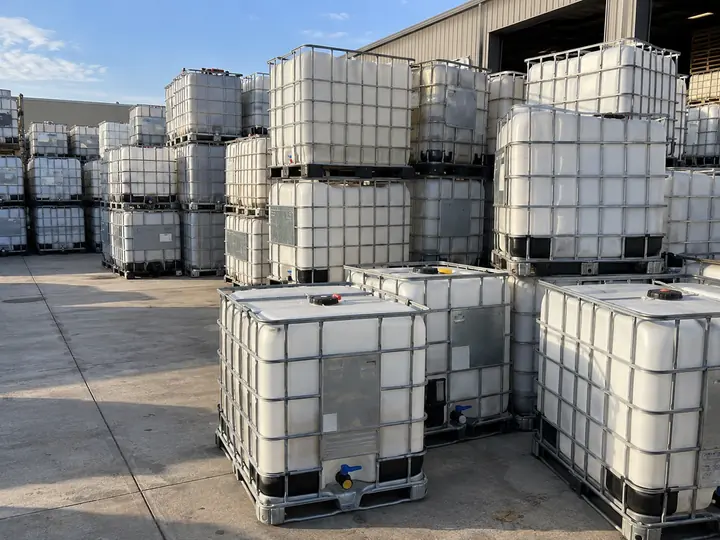
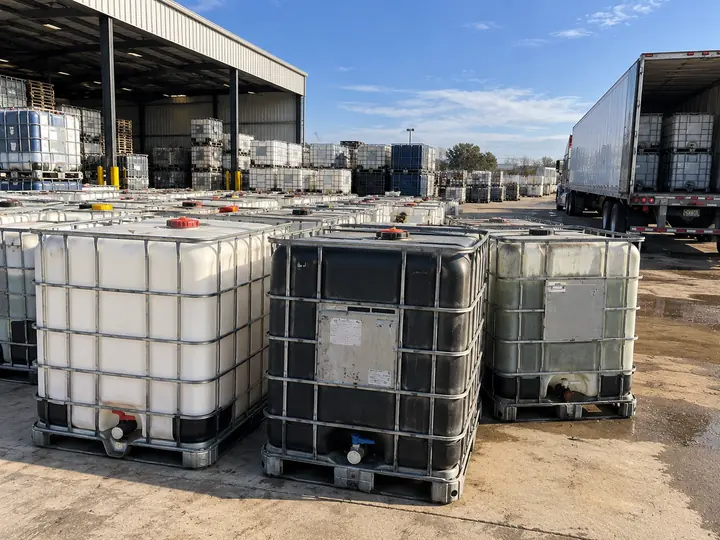
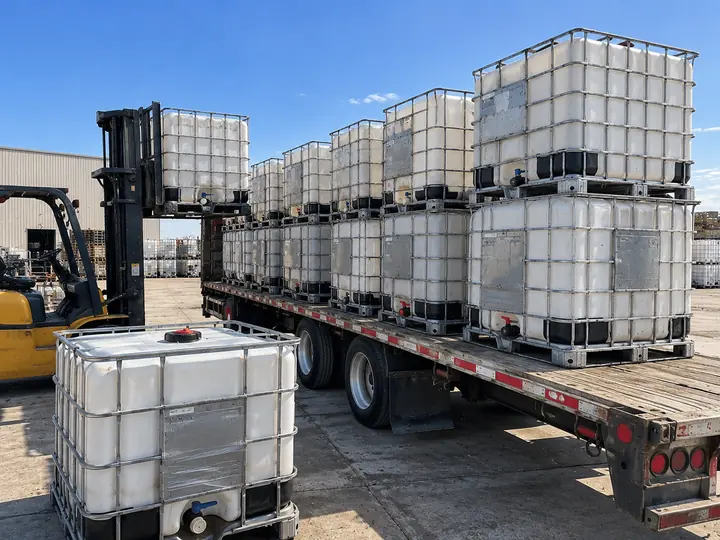
Michigan concrete, a flatbed mid-load and the stacks these containers sit in between lives. No stock imagery anywhere on this site.
Documents we will send in one email.
Ask for the vendor pack and all of this arrives together, usually inside the hour.
- W-9
- Certificate of insurance — general and product liability
- Wash bay standard operating procedure, covering all four routes
- Sample wash record and sample leak test record
- Prior-contents declaration template for your own fillers
- Industrial wastewater discharge permit number and latest sampling summary
- Impact methodology document with the full factor table
- A signed statement of what we are NOT certified for — the honest half
- Hazardous waste generator registration details for residual streams
- Record retention policy and how to request a reissue against a cage ID
Cargo we will not accept, at any price.
Published because an undeclared container in a recirculating wash system can affect a hundred units before anybody notices. The upside of accepting one is a trailer's margin; the downside is a drained loop and a contaminated batch.
- Pesticides and herbicides — residues persist in HDPE at agronomically significant levels
- Pharmaceutical actives — potent at trace levels with no validatable removal route here
- PFAS-containing formulations, including firefighting foams
- Isocyanates — they cure, and a cured film is a lining no wash removes
- Radiological material
- Anything that has been in a fire — heat-affected HDPE is structurally unpredictable
- Polymerising oils such as tung and linseed
- Any cargo nobody will name in writing, which overrides every other line on this list
Operational questions, answered at length.
How fast can you turn an order around?
Grade B and C from floor stock, usually the same week. Grade A washed, two to five business days. Rebottled, five to ten because bottles are fitted to order. Then add transit for your zone.
Wash bay throughput is about 90 units a day on Route 1 or 2 and 55 on Route 3. In practice turnaround is set by inspection and photography, not by washing.
Do you work with public buyers?
Regularly — municipalities, fire departments, school districts, county emergency management and state agencies.
Itemised quotes with freight on a separate line, W-9 and insurance certificates in one email, sealed bids where required, and we will hold stock against a purchase order that has not cleared yet if you tell us the situation.
Can you run a fleet programme for containers I own?
Yes, and it is a large part of what the bench does. Out full, back empty, washed, inspected, gasket replaced, leak tested, back on your fill line.
Priced per unit against a defined scope with a guaranteed turnaround, plus a quarterly fleet health report forecasting how many cages and bottles are approaching end of life. That report is the part customers say they value most.
What is the single best way to cut my container cost?
Measure your real cycle time, which is almost always worse than you think. Annual fills divided by fleet size: most operators assume eight turns a year and measure four to five.
Fleet size is throughput multiplied by cycle time, so halving cycle time halves the containers you need. Scheduled collection rather than requested collection is the single biggest lever, and it costs nothing.
Do you ship internationally?
Yes. Steel or plastic pallets to avoid ISPM 15 timber treatment requirements, double-stacked empties because ocean freight is priced per container, and a wash record plus prior-contents documentation in the pack.
Twenty-two units floor-loaded in a 40-foot container, forty-four double-stacked empty. Block and brace properly: ocean movement is far more violent in the vertical and roll axes than road movement.
Why is there no phone number?
Cargo declarations have to be written to be worth anything, a container quote involves nine variables that nobody holds accurately in conversation, and most of our customers are on a forklift rather than at a desk.
Every form submission is read by a person and answered within one business day, usually much sooner. Nothing is agreed that is not written down. For genuinely complex work we will schedule a video call.
The grading system, in one table.
| Grade | Prior cargo | Wash route | Clean index | Price index | Drops a grade if |
|---|---|---|---|---|---|
| A — Food | One, food only, documented | Route 3 potable triple rinse | 100 | 100 | More than one cargo, missing declaration, film on scope, odour fail |
| A — Rebottled | None — new bottle | New, unused | 98 | 86 | Cage fails node inspection or leak test |
| A — Washed | Non-hazardous industrial | Route 2 hot caustic | 92 | 74 | Ghosting remains, or cargo history unverifiable |
| B — Rinsed | Mixed industrial | Route 1 rinse | 72 | 52 | Structural repair, or odour a buyer would notice |
| C — Non-potable | Heavier residue, repaired | Route 1 rinse | 48 | 34 | Any crazing, any persistent bulge, failed leak test |
| D — Reclaim | Failed test or structure | Not resold | 16 | 9 | Not applicable — this is the floor |
Price index is relative to Grade A food at 100, not a quote. The absolute level moves with resin, scrap steel, freight rates and the agricultural season.
Questions about container condition.
Should I buy translucent or black bottles?
Translucent indoors, black outdoors, every time. Translucent gives you level visibility for free; black gives you three to four times the outdoor life.
We measured twelve translucent units pulled after four to six years outdoors: south walls 0.21 mm thinner than north walls on the same unit, chalking on every south and west face, and coupons that snapped like a biscuit when folded.
How do I tell how old a container is?
Three independent sources, and they do not always agree. The UN plate carries a date of manufacture for the assembly. The bottle has a moulded date wheel — a clock face with the month and a two-digit year. The cage usually has a stamped week-and-year code on the lower rail, right-hand side facing the outlet.
Bottle newer than plate means a rebottle. Plate newer than cage stamp means a recertification. We list all three separately on every unit and say why when they conflict.
What is crazing and how do I spot it?
A network of microscopic voids in stressed polymer — the immediate ancestor of a crack, and the reason most reclaimed bottles are eventually scrapped.
It is nearly invisible head-on. Put a light behind the bottle wall, get your eye within fifteen degrees of the surface and look along it: crazed regions light up as a silvery sheen that moves as you shift your head. Check all four lower corners and the sump transition. Thirty seconds per unit.
Is a bulged bottle still usable?
Empty it and look again. If the bulge goes, you have an overfilling or thermal problem and the container is fine. If it remains when empty, that is creep — permanent deformation under sustained load — and the unit should not be refilled.
A bulge that includes the top of the bottle rather than the bottom means gas generation, which is a hazard rather than a defect. Vent slowly from the side with the cap pointed away.
Why does the outlet leak?
In order of likelihood: the dust cap is loose or missing; the flat gasket between valve body and bottle neck has taken a compression set; the butterfly valve liner has set in the open position; the bottle neck is crazed around the thread root; or the sump has failed.
The first two are cheap fixes. The last two condemn the bottle. Full diagnostic order is in our valve field guide.
Can I use a poly tote for solvent or fuel?
Not a standard one. Polyethylene has a surface resistivity around 10^16 ohms per square — one of the best insulators in industrial use — so flow electrification charges the liquid with nowhere for the charge to drain.
Worse, the galvanised cage around an insulating bottle is a classic isolated conductor: it accumulates charge by induction and discharges in a single energetic spark. Use a steel or stainless bin, or a purpose-made conductive IBC with a bonding lug.
The pages our own staff keep open.
Rinse verification: the numbers behind a wash record.
| Measurement | Method | Pass tolerance | What it actually proves |
|---|---|---|---|
| Third-rinse conductivity | Inline probe, µS/cm | Within 10% of supply water | No dissolved residue carrying over |
| Supply water baseline | Measured each shift | Logged, not assumed | The comparison has a real datum |
| pH of final rinse | Probe | 6.5 – 8.0 | Caustic or acid fully flushed |
| Visual, 360° internal scope | Borescope on a mast | No film, no shadow, no deposit | Nothing clinging above the heel line |
| Odour, cap off, ambient | Two operators independently | Neither detects cargo | The check a buyer will make themselves |
| Wash temperature | Bay thermocouple, logged | Route 2 and 3: 140–160 °F | The chemistry ran where it works |
| Dwell time | Cycle timer, logged | Per route specification | Not a quick splash through |
| Rinse count | Counted charges, logged | Route 3: three full potable | Dilution did the work, not optimism |
| Drain-down | Inverted dwell | Under 100 ml retained | No pooled water to go stale in storage |
| Leak test after wash | Pneumatic pressure decay | Under 1 kPa in 10 min | The wash did not find a weakness |
Conductivity against the day's supply water is the measurement that matters, and it is the one most wash records leave out. A number with no baseline is decoration. Ask any supplier what their third rinse read and what the tap read that morning.
Fourteen stations: what happens between the gate and the truck.
A container that arrives on a Monday morning and leaves as Grade A food on Thursday has been through fourteen stations, and at eight of them it can lose a grade or be pulled out entirely. This is the route, in order.
1 — Gate and declaration
Nothing comes off the trailer without a named prior cargo in writing. No name, no entry; the load goes back. This is the single rule that protects everything downstream, because one undeclared pesticide tote in a recirculating wash loop can affect a hundred units before anybody smells it.
2 — Exclusion screen
The declared cargo is checked against the published exclusion list. Pesticides, pharmaceutical actives, PFAS formulations, isocyanates, radiological material, fire-affected units and polymerising oils are refused outright, whatever the condition and whatever the price.
3 — Heel drain and measure
Residual cargo is drained, measured and routed to the correct waste stream. Under a gallon is normal. Above five gallons the load is a liquid-waste job rather than a container job, and it is priced or refused as one.
4 — Weigh and log
Yard scale, not a unit count. Every published tonnage on this site traces back to this scale, which is why our disposition table reports weight and units separately and why they do not divide into each other neatly.
5 — Cage and base inspection
Node by node, 44 to 54 of them, counted rather than sampled. Diagonals measured. Base welds loaded and watched. Galvanising checked at the welds, which is where it always goes first.
6 — Bottle condition
Wall thickness at four points, raking light across the whole surface for crazing, sump checked for stress whitening, mid-wall measured for bulge against a datum. This is where most grade losses happen, and none of them are about cleanliness.
7 — Wash route assignment
Decided here, by prior cargo, by an inspector — not at the sales desk by price. A food cargo goes to Route 3 whether the customer asked for it or not; an industrial cargo cannot buy its way onto Route 3.
8 — Wash
Route 1 rinse, Route 2 hot caustic, Route 3 potable triple rinse, or Route 4 to a customer's own written SOP. Temperature, dwell, rinse count and chemistry dosing are logged against the cage ID as it happens, not reconstructed afterwards.
9 — Rinse verification
Third-rinse conductivity against the day's measured supply water, final pH, 360-degree internal scope, and an independent two-operator odour check with the cap off. Any one of them failing sends the unit back to station 8.
10 — Hardware
New gasket on every Grade A and B unit, no exceptions. Valve function-tested and replaced if scored. New cap. Adapter threads checked under a light. Tamper seal on anything food-grade.
11 — Leak test
Pneumatic pressure decay on the complete assembly, under 1 kPa loss in ten minutes. Method, pressure, hold time and measured decay are written to the record — a pass with no numbers behind it is not a leak test.
12 — Grade and passport
The grade is assigned against the published criteria and written to the passport with the cage ID, the wash route, the test dates and the operator who did it. Seven years of retention, reissuable on request.
13 — Photography
Four shots of the actual unit plus the cage stamp, bay number visible. These go to the customer before payment. It started as a way of ending arguments about Grade B and became our best quality control, because an inspector who knows the photograph goes out grades more conservatively.
14 — Bay and load plan
Into one of 168 numbered bays by grade and configuration, then load-planned against trailer capacity. Twenty on the floor, forty double-stacked empty. If your order is twenty-two units, this is the station where somebody emails you to suggest twenty or forty.
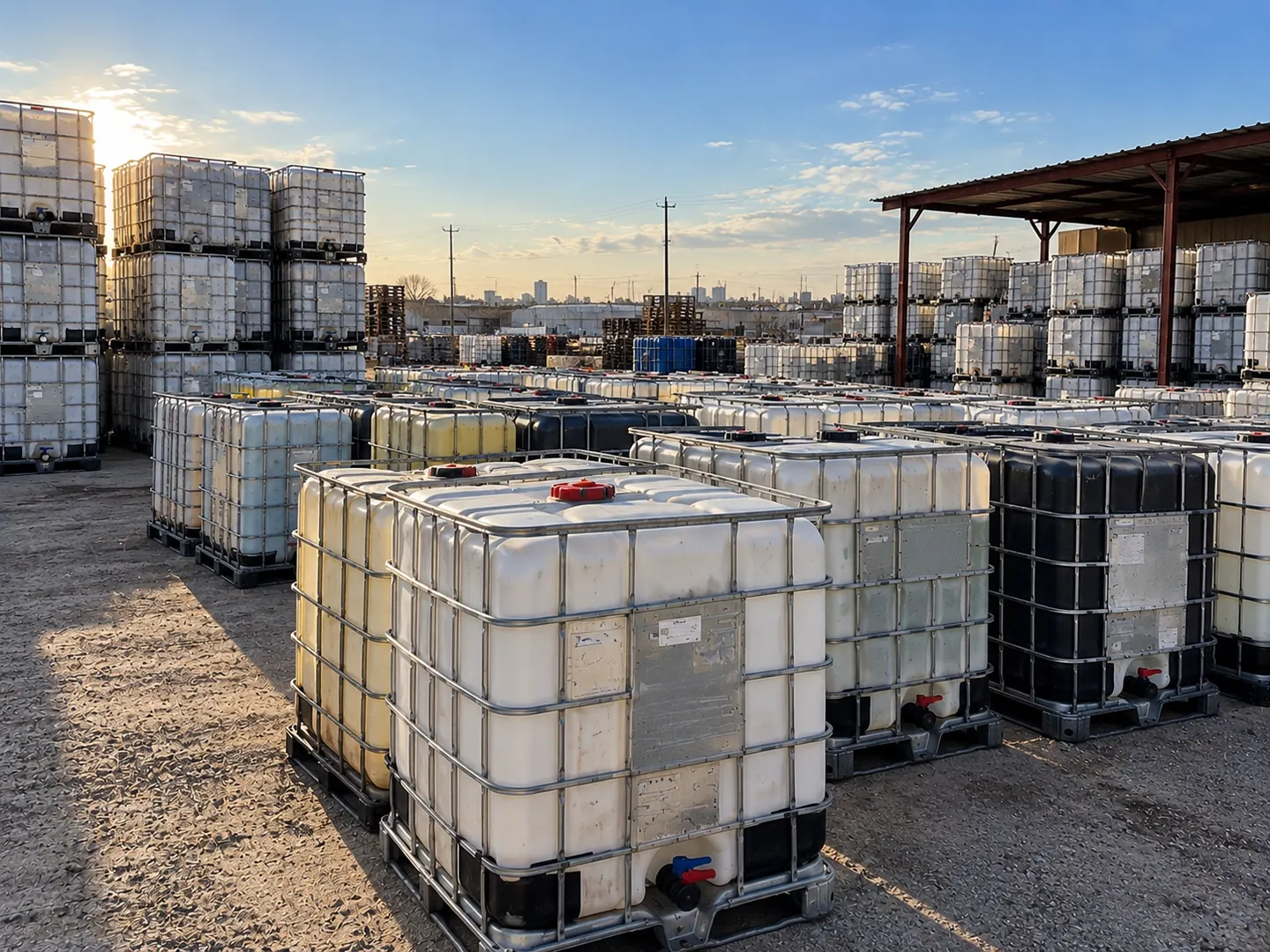
Stock waiting on inspection.
The twenty-two point intake inspection.
| # | Check | Pass criterion | Fail consequence |
|---|---|---|---|
| 01 | Prior-contents declaration present | Named product, filler, fill date | Quarantine bay until named, or refused |
| 02 | Cargo against exclusion list | Not on the published list | Refused at the gate, load turned away |
| 03 | Residual heel volume | Under 1 gal, drainable | Charged back, or refused above 5 gal |
| 04 | Odour, cap off, ambient | No detectable cargo odour after rinse | Drops to Grade C or reclaim |
| 05 | Bottle wall thickness, four points | Within 15% of nominal | Reclaim |
| 06 | Crazing under raking light | No branching cracks anywhere | Reclaim — crazing never improves |
| 07 | Stress whitening at the sump | None, or faint and non-progressive | Grade C maximum |
| 08 | Bulge, measured at mid-wall | Under 6 mm from datum | Grade C or reclaim by severity |
| 09 | UV chalking on the sun face | Surface only, no wall loss | Grade C for outdoor-only use |
| 10 | Neck thread condition | Clean start, two full turns by hand | Rebottle or reclaim |
| 11 | Internal scope, 360° | No film, no deposit, no shadowing | Re-wash, then regrade |
| 12 | Weld node count and integrity | 44–54 nodes, none cracked | Cage repair or scrap the cage |
| 13 | Cage geometry, diagonal check | Within 10 mm across diagonals | Press back or scrap |
| 14 | Galvanising condition | No red rust through the zinc | Grade C, or wire-brush and paint |
| 15 | Base weld to pallet | All welds sound under load | Scrap the base, transplant the bottle |
| 16 | Pallet type and ISPM stamp | Matches order; stamp present if export | Re-sorted to the correct bay |
| 17 | UN plate legible | All fields readable, dates in date | Sold as non-regulated service only |
| 18 | Leak test, pneumatic decay | Under 1 kPa loss in 10 min at test pressure | Repair and retest, or reclaim |
| 19 | Valve function, full travel | Opens, closes, seals dry | Valve replaced |
| 20 | Gasket condition | Not reused on A or B — always new | New gasket fitted |
| 21 | Photographs, four plus cage stamp | In focus, bay number visible | Reshot before despatch |
| 22 | Passport record written | Cage ID, grade, route, dates, operator | Unit does not leave the yard |
Checks 05 to 09 are where most units lose a grade, and they are all condition of the bottle rather than cleanliness. A container can be surgically clean inside and still be Grade C because of what five Michigan winters did to the outside.
Washing, testing and verification.
Why can't I buy my way onto the potable wash route?
Because the route is assigned at inspection by prior cargo, not at the sales desk by price. A unit that held an industrial product does not become a food container by going through Route 3 — the prior cargo is part of what Grade A food means.
If you need a food container and the available stock has industrial history, the answer is rebottling: a new bottle in an inspected cage. That is a real solution to the problem rather than a more expensive wash on the wrong unit.
Do you wash to a customer's own procedure?
Yes — Route 4. You send the written SOP, we run it and log every parameter it names: temperature, dwell, chemistry and dose, rinse count, verification method, operator, timestamps, all against the cage ID.
This is usually the cleanest way to satisfy an auditor, because the record is in your own format and names your own steps rather than asking somebody to accept ours by analogy.
How do I know the wash record belongs to the container I received?
The cage ID. Every record — intake, wash, leak test, grade, photographs, operator, dates — is keyed to the stamp on the cage you are holding, and the despatch photographs include a shot of that stamp.
Retention is seven years and reissue is a matter of emailing us the cage ID. People do this years later, usually because an auditor has asked a question about a container bought by somebody who has since left.
What does a leak test actually involve?
Pneumatic pressure decay on the complete assembly: pressurise to the design test pressure, hold, and measure the loss. Our pass criterion is under 1 kPa in ten minutes, and the record states method, pressure, hold time and measured decay.
A leak test record with no numbers on it is not a leak test record. That is the single most useful thing to check on any supplier's paperwork, including ours.
Is there anything a wash cannot fix?
Plenty. Crazing, wall loss, a persistent bulge, cracked weld nodes, a failed base weld, heat exposure, an illegible plate — none of those are cleanliness problems and no wash route touches them.
And some cargo we will not try: pesticides, pharmaceutical actives, PFAS formulations, isocyanates, polymerising oils, radiological material, anything fire-affected, and anything nobody will name in writing. Those are refused at the gate, because the downside of being wrong is a drained loop and a contaminated batch.
What is the difference between rinsed and washed?
Route 1 is a rinse: one or two drained charges at ambient to 100 °F, verified visually. It produces Grade B and it is appropriate for a great deal of industrial and agricultural work.
Route 2 is a hot caustic wash: 140 to 160 °F, dosed alkaline detergent, three cascade charges, verified by conductivity and borescope. It produces Grade A washed. The gap between them is not a detail — it is the difference between a container that looks clean and one with a measured number behind it.
How can three rinses use only 11.5 gallons of fresh water?
Because the rinses cascade. The third rinse on one unit becomes the second rinse on the next and the first on the one after, so fresh water enters at the clean end and leaves at the dirty end. Eighty-six percent of bay water is recirculated.
It also means the direction of flow matters more than the volume, which is why the measurement we care about is third-rinse conductivity against the day's measured supply water rather than gallons used.
Washed, or rebottled?
This is the decision that most often gets made on price and should be made on history. The cage and base are the same in both cases — the question is only ever about the bottle.
Washed is right when
- There is a documented prior cargo and it is compatible with your use
- Your cargo is industrial, agricultural or utility
- Food in the same category as the prior cargo, with the declaration in hand
- You want the lower price and the lower embodied impact — nothing new was made
- Ghosting or staining is acceptable: it is cosmetic, and it costs a grade you may not need
- You need units quickly: Route 1 and 2 run at 90 a day
Rebottled is right when
- Drinking water, or any potable application
- Allergen-claim products, infant products, or high-purity and DI water
- An auditor has asked for virgin packaging where it touches the cargo
- The prior cargo cannot be verified, which disqualifies washed stock outright
- You want a plate with a current date and a fresh test clock
- You can wait: bench turnaround is 48 hours on contract work, 3 to 10 days on orders
Rinsing a tote yourself: what works, what is theatre, and what is dangerous.
Sometimes you have a unit on site and a job to do. Here is what you can realistically achieve with a pressure washer and a hose, and where the line is.
First, the thing that is actually dangerous
Never put your head or an arm inside an IBC, and never let anyone else. It is a confined space. A tote that held a solvent, a fermenting product or anything that displaces oxygen can be lethal with no smell and no warning, and people die in containers this size every year. Everything below is done from outside the unit.
What you can do
A hot water rinse with a wand through the 6-inch port, three drained charges, will take a water-soluble cargo residue down to a level that is fine for irrigation, dust suppression, ballast or washdown. Drain fully between charges — dilution only works if the previous charge leaves. Invert or tip to drain the sump, because the heel is where everything concentrates.
What makes a real difference
Heat, agitation and a new gasket, in that order. Warm water does more than cold at any pressure. A spinning wand beats a static one. And replacing the gasket and cap costs a few dollars and removes the most common source of carried-over odour — the elastomer holds the prior cargo and no amount of rinsing the bottle addresses that.
What is theatre
One cold rinse and a sniff. Bleach into an unrinsed tote, which mostly produces a tote that smells of bleach and cargo. Detergent with no heat and no dwell time. And any process that does not include draining the sump, which is where the problem lives.
What you cannot do on site
Produce a food-grade container. Route 3 is three full potable charges at 140 to 160 °F with dosed food-safe chemistry, verified by third-rinse conductivity against measured supply water, a borescope and two independent odour checks. That is a bay, not a bucket. If the end use is food, potable water or anything with an audit behind it, buy rebottled or Grade A food — the premium is smaller than the risk.
And the legal bit
Your wash water is now an effluent carrying the prior cargo. Down a storm drain it is a reportable discharge in most jurisdictions. We hold an industrial wastewater discharge permit and publish the number in our vendor pack; a yard hose does not come with one.
The UN plate, decoded field by field.
| Field | Example | What it means | Why it matters to you |
|---|---|---|---|
| Container type | 31 | 31 = rigid IBC for liquids; 11 = for solids, gravity discharge | A 11-series unit is not rated for liquid, whatever it looks like |
| Material code | HA | H = plastic inner, A = steel outer. HZ = composite with other outer | HA1 is the common caged tote; HZ2 is a different animal |
| Design category | 1 | 1 = pressurised filling or discharge permitted; 2 = gravity only | A 31HA2 cannot legally be pressure-filled |
| Packing group | Y | X = PG I, II, III; Y = PG II, III; Z = PG III only | Y will not carry a PG I cargo no matter how clean it is |
| Month and year | 0324 | March 2024 manufacture of the complete assembly | Starts the 2.5 and 5 year test clocks |
| State of authorisation | USA | Country whose competent authority approved the design type | Needed for cross-border movement |
| Manufacturer / approval | M4518 | Approval holder and design type reference | How a periodic tester traces the original design |
| Stacking load | 2,500 kg | Permissible superimposed load, often on a second line | Zero means do not stack even empty |
| Max gross mass | 1,200 kg | Total permitted filled mass | The binding limit — not your forklift rating |
| Test pressure | 100 kPa | Hydraulic or pneumatic test pressure of the design type | Pressure discharge is only allowed inside this figure |
| Periodic dates | 03/26 · 03/29 | Last 2.5 year leak test and 5 year inspection | Out of date means out of regulated service until retested |
This summarises how the plate is laid out in practice, not the regulation itself. Where a cargo is regulated, your obligations come from 49 CFR in the United States or the TDG regulations in Canada, and your own compliance team has the final word.
The regulatory picture, in plain language.
This is a summary of how the rules work in practice, written so that you know which questions to take to your own compliance team. It is not legal advice and we are not your compliance team.
Two separate questions
First: is your cargo regulated for transport? If it has a UN number and a hazard class, the container needs to be a marked, in-date, design-approved packaging, and almost everything else follows from that. Second: is your cargo regulated for storage or use? That is a different body of rules — fire code, secondary containment, state environmental regulation — and a perfectly compliant container can still be in the wrong place on your site.
If the cargo is regulated for transport
The container needs a legible UN plate whose design category, packing group, maximum gross mass and test pressure all suit the cargo, and whose periodic test dates are in date: leak test every 2.5 years, full inspection and leak test every 5 years. A 31HA1 marked Y will not carry a Packing Group I cargo. A 31HA2 cannot be pressure-filled. Those limits are properties of the design type, not of how clean the unit is.
If the cargo is not regulated
Most of what moves in reclaimed totes — water, glycols, fertilisers, food products, utility liquids — is not regulated for transport, and the UN plate stops being a legal document and becomes a quality signal. This is why units with faded plates are good value: the container is sound, it has simply lost its licence for a job you were not asking it to do.
Who is responsible for what
The filler is responsible for the condition of the packaging at the moment of filling. That is the sentence worth internalising, because it means a supplier's wash record and leak test are inputs to your own decision, not a transfer of liability. Your incoming inspection matters, and the twelve-minute check elsewhere on this page exists for that reason.
What we will put in writing
The prior cargo and its filler. The wash route with every logged parameter. The leak test with its actual numbers. The UN plate photograph and the periodic dates. The gasket and hardware specification. And a signed statement of what we are not certified for, which is the half of a vendor pack most suppliers omit.
What we will not do
Tell you that a reclaimed container is compliant for your cargo. We do not know your cargo, your mode of transport, your jurisdiction or your customer's audit. We will give you every fact we hold about the container, promptly and in writing, and your own people make the call.
Valves, caps and how each one fails.
| Component | Typical material | Service | How it fails | Our policy |
|---|---|---|---|---|
| Butterfly valve, 2 in | HDPE body, EPDM seat | General liquid | Seat takes a set and weeps after long storage open | Replaced on every Grade A unit |
| Ball valve, 2 in | PP body, PTFE seat | Chemical, viscous | Handle shears; ball scores on grit | Function-tested, replaced if scored |
| Camlock adapter, type A/F | Aluminium or poly | Hose connection | Thread galls, cam arms bend | Supplied new where ordered |
| Dust cap, type DC | Poly | Transport closure | Lost in transit, never replaced | Fitted before despatch, always |
| Screw cap, 6 in solid | HDPE | Storage and transit | Gasket compression set; overtightening crazes the neck | New cap and new gasket on Grade A |
| Screw cap, 6 in vented | HDPE with one-way vent | Dispensing only | Pumps moist air in during storage | Supplied only when asked for, with a warning |
| Bung insert, S60×6 / S70×6 | HDPE | Adapter seat | Cross-threaded by force | Checked for thread damage under a light |
| Tamper seal | Nylon or wire | Evidence of opening | Cut and discarded, then nobody can tell | Fitted on all food-grade despatches |
| Breather valve | PP with PTFE disc | Off-gassing cargo | Blocked by crystallisation | Recommended for hypochlorite and peroxide |
| Internal dip tube | HDPE | Pump suction | Trapped residue; blocks a wash route | Removed and washed separately, or discarded |
Gaskets are the cheapest component in the assembly and the single most common cause of carried-over odour. We do not reuse them on any Grade A or Grade B unit, and we will not sell you a food-grade tote with its original gasket in it.
Container condition, answered at length.
Do you have 350 and 500 gallon containers?
Yes, as stainless bins rather than caged composites. A 350-gallon square 304 bin is 48 × 42 inches and 55 inches tall with a 420 lb tare; a 500-gallon cylindrical 316L is 52 inches in diameter, 74 tall, 580 lb.
They are the right answer for aggressive acids above SG 1.6, for hot cargo, and for anything where you want a container that will outlive several poly ones. They do not stack, and the trailer count drops to fourteen for the 500s.
What is the heaviest cargo you would put in a reclaimed poly tote?
In practice, 50% caustic soda at SG 1.53 in a 275 — which grosses 3,637 lb — is about where we stop being comfortable, and we check the customer's forklift rating before quoting it.
Sulphuric acid at 93% and SG 1.83 we will not put in poly at all; that is steel or stainless service. The limiting factor is rarely the bottle's burst strength and almost always everything underneath it: forks, beams, floors.
How do I work out whether my cargo is too heavy for a 330?
Multiply litres by specific gravity to get kilograms, or gallons by 8.34 by specific gravity to get pounds, then add the tare — 127 lb for a 275, 145 lb for a 330 — and compare against the maximum gross mass on the UN plate.
The plate figure is the binding one. As a rough guide, cargo above about SG 1.4 belongs in a 275 rather than a 330 simply because the taller bottle puts more mass on the same footprint, and above SG 1.6 you are usually looking at lined steel or stainless rather than poly.
What is the difference between a 275 and a 330, apart from volume?
Height, mostly. Both sit on the same 40 × 48 inch footprint; the 275 is 46 inches tall in the standard build and the 330 is 53. The trailer count is identical at twenty on the floor, which surprises people.
The consequence is density: a 330 full of anything heavy puts more mass on the same square footage, so forklift ratings, racking and floors all need checking against the real figure. For dense cargo, two 275s beat one 330 and a half.
How do I tell which buttress thread I have?
Measure the outside diameter of the male thread: roughly 60 mm is S60×6, 70 mm is S70×6, 75 mm is S75×6. S60×6 is the European norm — Schütz and Werit — and S70×6 covers Mauser and most North American bottles.
The reason this matters is that all three will start on each other and then bind after a turn or two. Two turns and a stop means the wrong standard. Forcing it crazes the bottle neck permanently, and a crazed neck is not repairable.
Which gasket do I need?
EPDM for water, glycols, caustics, fertilisers and most food products. Viton for acids, hydrocarbons, solvents and anything aromatic. PTFE for aggressive oxidisers and where nothing else is rated.
The two expensive errors are EPDM in hydrochloric acid, where it is destroyed in weeks, and EPDM in hydrocarbons, where it swells. If you tell us the cargo we specify the elastomer, and it is on the component list that ships with the unit.
What does the stacking figure on the plate actually mean?
It is the permissible superimposed load: how much mass may sit on top of that container. It assumes normal temperature, level ground and an evenly distributed load, and a zero means do not stack even empty.
The real-world caveat is temperature. Above 100 °F derate by half; above 120 °F do not stack at all. HDPE creeps under sustained load and heat accelerates it, so a stack that was fine in April can deform in July without anything else changing.
Lead times, honestly, by grade and quantity.
| Order | Grade A food | Grade A washed | Grade B | Grade C | Rebottled |
|---|---|---|---|---|---|
| 1–4 units | 2–4 days | Same or next day | Same or next day | Same day | 3–5 days |
| 5–19 units | 3–6 days | 1–3 days | 1–2 days | Same or next day | 5–8 days |
| 20 (one trailer) | 5–8 days | 2–4 days | 2–3 days | 1–2 days | 7–10 days |
| 21–60 | 1–2 weeks | 4–8 days | 3–6 days | 2–4 days | 2–3 weeks |
| 61–200 | 2–4 weeks | 1–2 weeks | 1–2 weeks | 4–8 days | 4–6 weeks |
| Over 200 or scheduled programme | By schedule | By schedule | By schedule | By schedule | By schedule |
Grade A food is slower than everything else because Route 3 runs at 55 units a day against 90 on the other routes, and because the paperwork is checked twice. In March to May, add roughly a week to Grade B and C — that is the agricultural pull, and it is the most predictable thing in this market.
When to retire a container, and what happens to it then.
| Trigger | Severity | Reusable parts | Material route | Take-back value |
|---|---|---|---|---|
| Crazing anywhere on the bottle | Absolute | Cage, base, hardware | HDPE flake, 68% recovery | Partial — cage and base credited |
| Wall loss over 15% of nominal | Absolute | Cage, base, hardware | HDPE flake | Partial |
| Failed leak test after repair | Absolute | Cage, base | HDPE flake | Partial |
| Heat or fire exposure | Absolute, no exceptions | Nothing — all refused | Energy recovery | None |
| Excluded prior cargo | Absolute | Nothing | Licensed disposal | None, and we will say why |
| Persistent bulge over 6 mm | High | Cage, base, hardware | HDPE flake | Partial |
| Cracked weld nodes, three or more | High | Bottle, base | Baled steel, 92% recovery | Partial — bottle credited |
| Base weld failure | High | Bottle, cage | Baled steel | Partial |
| Odour that will not clear | Medium | Cage, base, hardware | HDPE flake | Partial |
| Illegible UN plate | Medium — regulated service only | Everything | Stays in non-regulated service | Full |
| Cosmetic staining | None | Everything | Back to service as Grade C | Full |
| UV chalking, surface only | None for utility use | Everything | Outdoor service as Grade C | Full |
Our standing offer is the same for all of it: when you are finished with a container, we collect and pay, including for units we will only break for material. That is cheaper for us than buying the same steel and resin on the open market, which is the whole argument for a take-back programme existing at all.
Selling us your empties, in six steps.
We buy containers in any condition, including units that will fail every test. Material has value, and a collection that only takes the good ones leaves you with a disposal problem.
1 — Count and name the cargo
How many units, what size, and what was in them — product name and the company that filled them. The cargo decides the price and whether we can take them at all; the condition decides the rest.
2 — Photographs, rough is fine
A phone photograph of the stack and a couple of close-ups of the worst units. We are not grading from photographs, we are checking for the obvious disqualifiers before sending a truck.
3 — Written offer, per unit, by condition band
Not one number for the lot. Good units, utility units and reclaim units are priced separately, so you can see what you are being paid for rather than taking an average on trust.
4 — We schedule onto a lane
If you are on one of our six weekly routes, collection is usually inside the week and costs nothing. Further out we combine with a delivery going your way, which is what backhaul utilisation of 41% is for.
5 — Weighed and counted on arrival
Yard scale, against the manifest. Any discrepancy comes back to you with the scale ticket, in both directions — we have paid out more than was offered more than once.
6 — Payment, and a disposition record
Payment on agreed terms, plus a written record of where your units actually went: resold, rebottled, upcycled, recycled to material, or the residual fraction. Several customers use that record in their own reporting, which is why it exists in that format.
Commercial questions about service work.
Do you charge for the documentation?
No, and we would rather you did not ask it as a question, because a supplier who charges for a wash record is telling you the record is a product rather than a byproduct of the process.
The prior-contents sheet, wash record, leak test, plate photograph, component list and passport ID come with every order. The vendor pack — W-9, insurance certificate, wash SOP, discharge permit, methodology, and the signed statement of what we are not certified for — arrives in one email, usually inside the hour.
What is the most expensive mistake buyers make?
Specific gravity, by a wide margin, and it is never the container that fails. A 275-gallon tote of 50% caustic soda grosses 3,637 lb rather than 2,420. What fails is a forklift, a racking beam or a warehouse floor rated for the water figure.
Second place is buying Grade A for a job Grade C does. Third is ordering twenty-two units. All three cost more than the containers did.
Can I rent instead of buying?
We do not rent, and the arithmetic is why: a reclaimed tote costs a fraction of a new one and holds residual take-back value at end of life, so for almost every use case buying and selling back beats renting.
Where people genuinely want rental, what they usually want is a scheduled programme — units delivered when needed, collected when finished, credited on return. That we do, and it behaves like rental on your cash flow without the premium.
Why is one supplier's Grade A cheaper than another's?
Because 'Grade A' is not a standard. It is whatever each supplier means by it, and the only way to compare two of them is to ask what would disqualify a unit from that grade and what records come with it.
A washed unit with one documented food cargo, a logged Route 3 wash, a new gasket and a leak test with numbers on it is a different object from a rinsed unit that looked clean. Both get called Grade A. One of them costs forty percent more and is worth it; the other is a gamble priced like a certainty.
Is it cheaper to buy twenty or to buy five, four times?
Twenty, nearly always, and the reason is freight rather than any volume discount on the containers. Twenty units fill the floor of a 53-foot van, so the freight per unit is at its lowest point on the whole curve.
The cliff is just past it: twenty-two units pays for two trailers to move two containers. If your number is anywhere near a trailer boundary, tell us it is flexible and we will tell you which way to move it.
Do you ever tell people to buy a cheaper grade?
Constantly, and it is the most reliable sales tactic we have. Roughly half the enquiries that ask for food-grade are for site water, dust suppression, ballast or fabrication, where Grade C does the same job for about a third of the price and lasts exactly as long under that treatment.
The money we lose on the first order we get back on the next four, and it means that when we do say you need rebottled, you can believe us.
What does take-back actually pay?
It depends on condition band and on what the cargo was, and we quote it per unit rather than as one number for the lot — good units, utility units and reclaim units priced separately so you can see what you are being paid for.
We pay for units that will fail every test, because a cage is 55 lb of steel at 92% recovery and a bottle is 42 lb of HDPE at 68%. Buying that material from you is cheaper for us than buying it on the open market, which is the whole economic argument for a take-back programme existing.
Cold weather: what freezing actually does, and the four rules.
We are in Livonia, Michigan. We see what winter does to containers every year, and almost all of the damage is avoidable with four decisions made in October rather than January.
What freezing does
Water expands about nine percent when it freezes, and it does not expand evenly — it grows from the coldest surfaces inward, which in a tote means from the walls toward a shrinking core of liquid. The pressure goes somewhere, and in an HDPE bottle it goes to the thickest, most restrained geometry: the lower corner next to the sump. That is why the crack is almost always in the same place, and why it usually appears on thaw rather than on freeze.
Rule one — fill water-based cargo to 85%
Leave the top sixteen percent of a 275 empty and the ice has somewhere to grow. This one decision prevents the great majority of freeze cracks we see. For a 275-gallon tote that is about 234 gallons, and the ribbing on most bottles gives you a usable visual mark at roughly the right height.
Rule two — never forklift a cold full tote hard
Below about −20 °F, HDPE is brittle rather than tough. The same impact that leaves a white mark in July cracks the wall in February. Slow approach, square entry, no dropping the last inch.
Rule three — solid cap, and a drain path
A vented cap in winter is a condensation pump: it breathes moist air in on every temperature cycle, and that water collects on top of the cargo. Solid cap for storage and transit. Store the unit where meltwater can drain away from the base rather than freezing around it, because ice around a steel base is how galvanising gets breached.
Rule four — warm the product, never the bottle
Cold cargo is a viscosity problem, not a blockage. Used motor oil wants to be above about 60 °F before you try to pump it. Warm the product in a heated space or with a blanket rated for IBC use; never apply direct flame, a torpedo heater pointed at the wall, or anything that puts a hot spot on the HDPE. Heat-affected plastic does not recover, and a bottle that has been locally overheated will fail later with no visible warning.
The cargo-specific cases
DEF (urea 32.5%) freezes at 12 °F, expands, and recovers its specification on thaw if it was not overheated — the container is the fragile part, not the fluid. Sodium hypochlorite loses strength steadily at any temperature and faster warm, so winter storage is actually kind to it. Latex products are finished if they freeze. Glycols are fine, which is rather the point of them.
How the container in your yard came to be shaped like that.
The modern caged IBC is a surprisingly young object, and almost every feature of it is the fossil of a specific problem.
Drums and nothing between
Liquids moved in 55-gallon drums or in bulk tankers. Anything in between meant handling dozens of drums, which is why the intermediate category was invented at all.
The first rigid composites
A blow-moulded plastic bottle inside a steel frame, sized to a pallet footprint so a forklift could handle it. The idea has not changed since.
The pallet footprint settles
40 × 48 inches in North America, 1,200 × 1,000 mm in Europe. Every trailer count on this site descends from that choice.
UN performance testing
Packagings began to be approved by design type and performance test rather than by prescription, which is where the 31HA1 marking family comes from.
Periodic testing arrives
The 2.5-year leak test and 5-year inspection cycle formalised, creating the date-stamped plate that decides whether a used unit can still carry a regulated cargo.
Reconditioning becomes a trade
Enough units in circulation, and enough value in a steel cage that outlasts three bottles, for washing and rebottling to be businesses rather than favours.
One bay and a used pressure washer
Re:IBCtote starts in a rented bay in metro Detroit, washing totes for local chemical blenders who could not get a straight answer about prior contents.
Grading gets published
We write down the disqualifiers rather than keeping them in an inspector's head, because the arguments about Grade B were taking more time than the washing.
The passport
Every unit gets a record keyed to its cage ID: intake, wash parameters, test results, grade, operator, dates. Seven-year retention, reissuable years later.
38,210 containers
Our largest year: 94.2% diverted, 4.4% residual published rather than rounded away, 4,281 tonnes of CO₂e avoided on factors we publish in full.
The same containers, different weather.
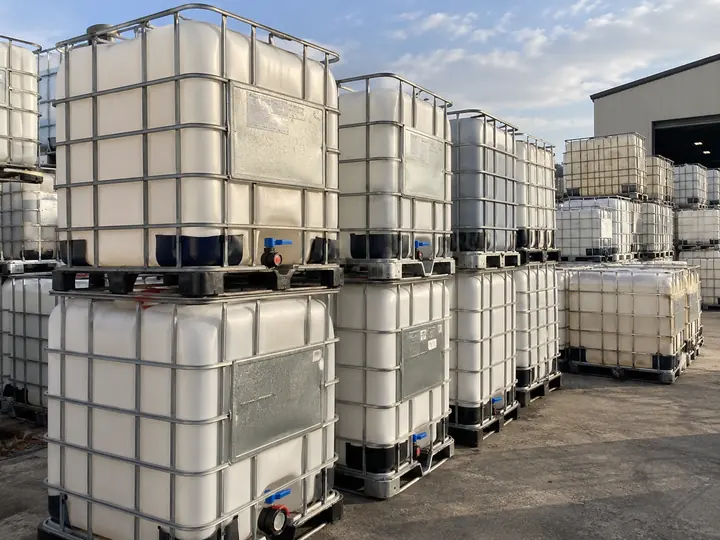
“An inspector who knows the photograph goes to the customer grades more conservatively. We started photographing every unit to end an argument, and it turned into the best quality control we have.”
Send us the cargo, not the grade.
Tell us what is going in the container and what you are doing with it, and we will name the grade, say what would disqualify a unit from it, and tell you if something cheaper does the job. That last part is why people come back.