Reclaimed totes in regulated service: entirely normal, if the records are right.
Blenders, distributors and specialty chemical plants are our most demanding customers, and the most loyal, because they care about exactly the things we built this business around.
Quote: Chemical & Industrial
Seven requirements, all of them answerable.
- A UN 31HA1 marking with a current periodic test date
- A documented prior cargo, not a shrug
- Gasket material matched to the actual cargo chemistry
- A leak test record that can be shown to an inspector
- Consistent supply, so a blending schedule does not stall
- Fleet reconditioning on a predictable rotation
- Someone who will say no when the answer is no
Common industrial cargo and what we would specify.
| Cargo | Container | Gasket | Note |
|---|---|---|---|
| Propylene glycol | Grade A washed poly | EPDM | The most common tote cargo in the Midwest |
| Ethylene glycol | Grade A washed poly | EPDM | Mark clearly — toxicity, not compatibility |
| Sodium hydroxide 50% | Grade A washed, 275 only | EPDM | SG 1.53; check forklift and plate rating |
| Hydrochloric acid 35% | Grade A washed poly | Viton | Vented cap at point of use, never in transit |
| Sulphuric acid 93% | Steel or stainless bin | PTFE | Not a poly tote application |
| Ferric chloride 40% | Grade B or C poly | Viton | Stains HDPE permanently; buy accordingly |
| Anionic surfactant | Grade A washed poly | EPDM | Expect residual odour after service |
| Latex and acrylic binder | Grade A washed poly | EPDM | Never let it dry in the sump |
| Mineral and hydraulic oil | Grade A washed poly | Buna-N | Hot wash route only |
| Aromatic solvent blends | Steel drum or stainless | Viton or PTFE | Poly totes are the wrong tool |
| Urea solution 32.5% | Grade A washed poly | EPDM | Freezes at 12 °F; plan storage |
| Deionised water | Rebottled | EPDM | Virgin interior or you lose your resistivity |
This table is a conversation starter, not a compatibility authority. Always check your own safety data sheet, and tell us the cargo so we can specify properly.
The rotation most blenders end up running.
A typical chemical blending customer runs three hundred totes on a loop: full out to the customer, empty back, washed, inspected, gasket replaced, leak tested, back on the fill line. Twenty to forty units in the wash cycle at any one time, with a float of spares to cover the gap.
We run that rotation for several customers on a per-unit price with a guaranteed turnaround, plus a quarterly fleet health report that forecasts how many cages and bottles are approaching end of life. The report is the part customers say they value most, because replacement capital arriving as a surprise is what ruins a quarter.
- Per-unit wash, inspect and test pricing
- Guaranteed turnaround windows
- Quarterly fleet health and replacement forecast
- Marking audit so nothing goes out of date unnoticed
- Your asset tags cross-referenced to our passport IDs
What plant managers ask first.
Can we legally ship hazmat in a reclaimed tote?
Yes, provided the container carries a valid design-type marking appropriate to the packing group, is within its periodic test dates, and the closures match the approved configuration.
Reclaimed status is not the issue. Expired testing is. Read UN / DOT markings explained and then send us your serial list for a free marking audit.
What if the prior cargo is incompatible with ours?
Then we will not sell you that unit. Our inventory records prior cargo by name specifically so this check can be made before the sale rather than after the first fill.
Where incompatibility risk is high or the cargo is high-purity, we steer you to rebottled: a new inner bottle removes the question entirely.
Do you carry liability insurance?
Yes, and we will provide a certificate of insurance on request as part of your vendor onboarding, along with our W-9 and our wash bay SOP.
We are used to being onboarded as a supplier to regulated plants. Ask for the pack and you will get it in one email.
How consistent is supply?
For Grade A washed 275s in common configurations, very. That is the deepest part of our inventory and we hold float stock specifically so blending schedules do not stall.
For unusual configurations — antistatic, pressure-rated, stainless — ask early. Those turn slowly and we will tell you honestly what the lead time looks like.
Which grade for which application.
| Application | Grade | Size | Gasket | Never use |
|---|---|---|---|---|
| Drinking water, any volume | A — rebottled | 275 gal | EPDM, FDA compliant | Any used bottle |
| Food ingredient, same category | A — food | 275 gal | EPDM, FDA compliant | Industrial-history units |
| Allergen-sensitive food | A — rebottled | 275 gal | EPDM, FDA compliant | Used bottles of any grade |
| Regulated chemical refill | A — washed, in-date plate | 275 gal | Specified to cargo | Out-of-date markings |
| High-purity or DI water | A — rebottled | 275 gal | EPDM | Used bottles |
| Fertiliser and fertigation | B — rinsed | 275 or 330 gal | EPDM | Food-grade stock — wasteful |
| Livestock water | B — rinsed, documented | 275 gal | EPDM | Unknown-history units |
| Compost tea and digestate | B — rinsed | 275 gal | EPDM, vented at use | Sealed caps — gas generation |
| Site water and dust control | C — utility | 275 gal | EPDM | Paying for appearance |
| Ballast and erosion control | C — utility | 275 gal | Any | New containers |
| Fire and standpipe reserve | C — painted, stencilled | 275 or 330 gal | EPDM | Translucent bottles outdoors |
| Flammable liquids | Steel or conductive IBC | Per design | Viton or PTFE | Standard poly totes |
| Aggressive acids above SG 1.6 | Stainless or lined steel | 350 gal | PTFE | Poly totes |
| Fabrication donor stock | C or D | Any | n/a | Food-grade donors |
Cargo weight by specific gravity.
| Cargo | SG | 275 gal net | 275 gal gross | 330 gal gross | Notes |
|---|---|---|---|---|---|
| Ethanol, 190 proof | 0.81 | 1,858 lb | 1,985 lb | 2,375 lb | Flammable — conductive container required |
| Used motor oil | 0.89 | 2,042 lb | 2,169 lb | 2,595 lb | Warm before pumping in winter |
| Canola oil, refined | 0.92 | 2,110 lb | 2,237 lb | 2,678 lb | Hot wash route only |
| Water | 1.00 | 2,294 lb | 2,421 lb | 2,898 lb | The baseline for everything |
| Propylene glycol | 1.04 | 2,386 lb | 2,513 lb | 3,008 lb | Commonest tote cargo in the Midwest |
| Urea solution 32.5% | 1.09 | 2,500 lb | 2,627 lb | 3,145 lb | Freezes at 12 °F |
| Hydrochloric acid 35% | 1.18 | 2,707 lb | 2,834 lb | 3,393 lb | Viton gaskets, never EPDM |
| Liquid cane sugar | 1.33 | 3,051 lb | 3,178 lb | 3,804 lb | Near the density limit for a 330 |
| Ferric chloride 40% | 1.42 | 3,258 lb | 3,385 lb | 4,052 lb | Stains HDPE permanently |
| Caustic soda 50% | 1.53 | 3,510 lb | 3,637 lb | 4,355 lb | 275 only; check the forklift rating |
| Sulphuric acid 93% | 1.83 | 4,198 lb | 4,325 lb | 5,208 lb | Steel or stainless service, not poly |
Gross figures include tare of 127 lb for a 275 and 145 lb for a 330 on steel pallets. The maximum net mass on the UN plate is a separate and binding limit.
What the stock actually looks like.
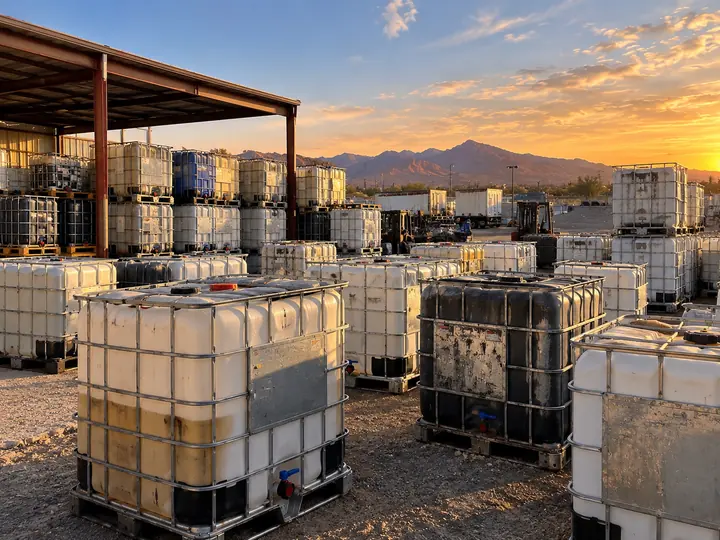
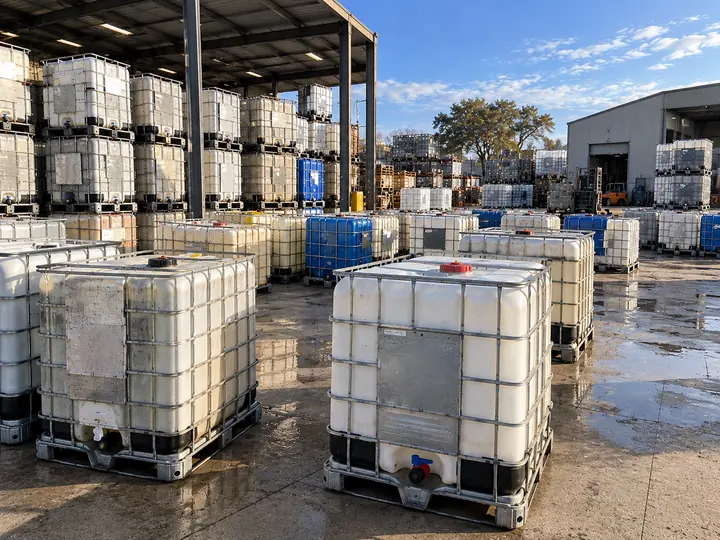
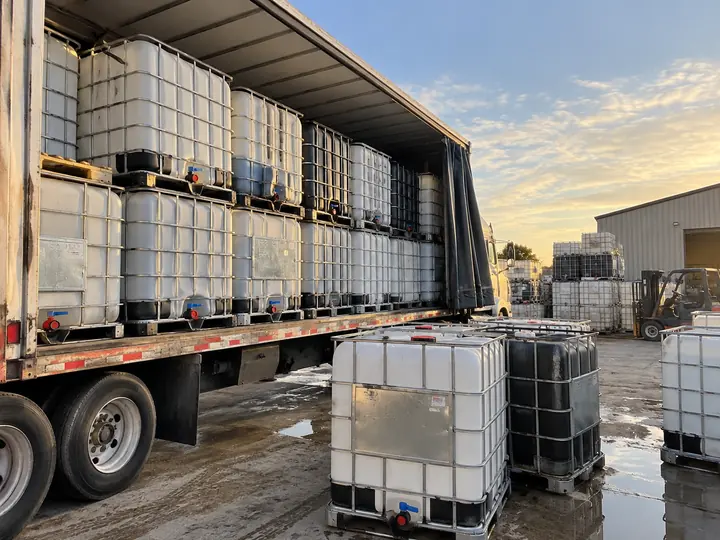
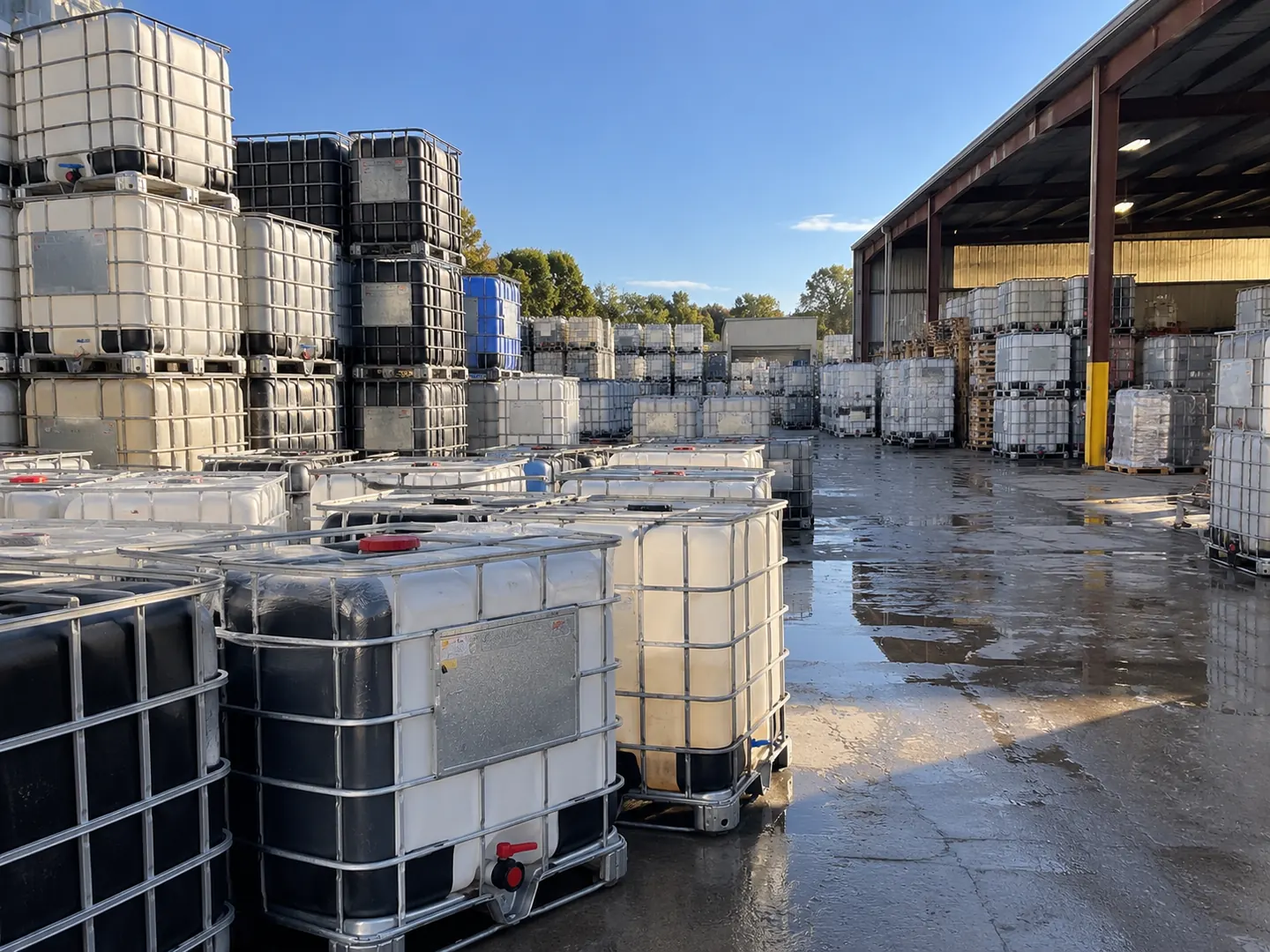
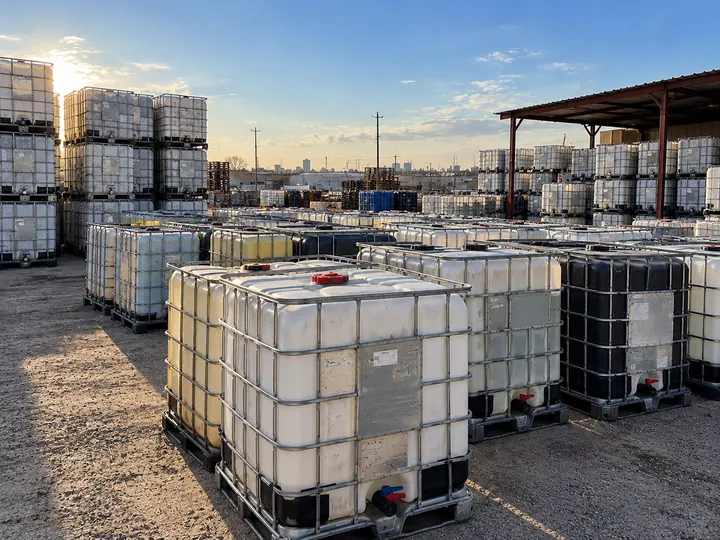
Unretouched frames from Livonia and from the road. Every unit you can see in them went through the same twenty-two point intake as the one we would send you.
The buying calendar, because this market is seasonal.
| Window | Availability | Pricing pressure | Best for | Avoid |
|---|---|---|---|---|
| January – February | Good across all grades | Soft | Grade A industrial stock, fleet contracts | Nothing |
| March – May | Grade B and C tight | Up 15–20% on B and C | Grade A, which barely moves | Buying Grade B for agriculture |
| June – August | Softening across the board | Lowest of the year on B and C | Grade B and C, stockpiling for spring | Nothing |
| September – November | Steady | Freight tightens before the holidays | Mixed loads, take-back collections | Leaving freight to the last week |
| December | Thin and variable | Unpredictable freight | Yard pickup | Tight delivery deadlines |
If your timing is flexible, buying Grade B in late summer rather than April is the single easiest saving available in this market.
What arrives with the containers.
None of this is optional or chargeable. It is the difference between a reclaimed container and an anonymous second-hand one.
- A prior-contents sheet naming the product, the fill date and the company that filled it
- Four photographs of the actual unit plus an image of the cage stamp
- The grade assigned, and the published criteria that grade commits us to
- A wash record where the unit went through Route 2, 3 or 4, with temperature, dwell, rinse count and final rinse conductivity
- A leak test record for every Grade A and Grade B unit: method, pressure, hold time and measured decay
- The UN plate photograph and periodic test dates where the unit is marked
- A component list naming gasket material, valve type and cap type
- The cage passport ID, so the whole service history can be reissued later
- An allergen flag where a prior food cargo included dairy, egg or tree-nut oils
- A standing take-back offer: when you are finished, we collect and pay
Buying questions for this sector.
What is the minimum order, really?
One unit, on every product line. There is no hidden minimum and no 'pallet quantity only' rule.
Freight is what makes single units expensive. Inside our six weekly lanes we will usually fold one tote into a scheduled route rather than quoting LTL, which is why a single-unit order to Toledo costs a fraction of a single-unit order to Dallas.
Can I see the exact units before paying?
Yes, and it is standard rather than a concession. Four photographs per unit plus the cage stamp, tagged to a bay number, emailed before payment.
This started as a way of ending a recurring argument about Grade B expectations. It turned into our most effective quality control, because an inspector who knows the photograph goes to the customer grades more conservatively.
How do I know the grade is honest?
Because the disqualifiers are published. A Grade A food unit drops to Grade A washed if there is more than one prior cargo, if the declaration is missing, if third-rinse conductivity is out of tolerance, if the scope shows film, or if the odour check fails.
Ask any supplier what would disqualify a unit from the grade they just sold you. A supplier who cannot answer immediately does not have a grading system.
What happens if a unit is not as described?
We replace it, re-grade and refund the difference, or collect it and refund in full — your choice, not ours.
We have refunded four units in the last three years. All four were our grading error, and all four customers still buy from us.
Do you substitute units without telling me?
No. Container reconditioning depends on inspection outcomes we cannot fully predict, so units occasionally fail during processing.
When that happens we tell you immediately and offer the nearest available alternative, rather than quietly shipping something different and hoping the photographs were not studied.
Can I specify valve, cap and gasket?
All three, on any grade. If you name the cargo we will specify them for you rather than making you learn three buttress thread standards and six camlock types.
The most expensive eleven-dollar mistake in this industry is EPDM in aromatic service. It swells, extrudes out of the joint and fails without warning.
Freight arithmetic, in one place.
| Vehicle | 275 gal filled | 275 gal empty | 330 gal filled | Drums on pallets |
|---|---|---|---|---|
| 53 ft dry van | 20 | 40 double-stacked | 20 | 80 |
| 48 ft dry van | 18 | 36 | 18 | 72 |
| 26 ft box truck | 10 | 20 | 10 | 40 |
| Flatbed, strapped | 20 | 20 (no stacking) | 20 | 60 |
| 20 ft ocean container | 10 | 20 | 10 | 40 |
| 40 ft ocean container | 22 | 44 | 22 | 88 |
| Pickup with trailer | 2–4 | 4–8 | 2–4 | 8–12 |
Twenty-two is the worst number of totes to order: a 53-foot trailer holds twenty, so twenty-two pays for two trailers to move two containers. We load-plan every multi-unit quote for exactly this reason.
Eight mistakes we watch customers make, repeatedly.
None of these are stupid. All of them are expensive, and every one of them has happened to somebody competent in the last twelve months.
1. Multiplying volume by 8.34 and forgetting specific gravity
A 275-gallon tote of 50% caustic soda grosses 3,637 lb, not 2,420. Forklift capacity ratings, racking beams and warehouse floors all care about the real number. This is the single most common serious miscalculation in liquid handling.
2. Buying Grade A washed for site water
Cosmetic condition has no effect on how well a container holds water for dust suppression. Grade C costs a third as much and lasts exactly as long under that treatment. Roughly half the customers who ask for Grade A are paying for appearance they do not need.
3. Fitting a vented cap for storage
A vented cap is a dispensing device. Left on a stored container it pumps moist air in all winter, and we have opened totes in March with half a litre of condensate sitting on top of the cargo. Solid cap in storage and transit; vent at the point of use.
4. Filling to the brim before a freeze
Water expands about nine percent on freezing and an HDPE bottle will crack at the lower corner near the sump almost every time. Fill water-based cargo to 85% and store where the unit can drain.
5. Reusing the gasket
The cheapest component in the assembly and the most common source of carried-over odour and cross-contamination. Gaskets take a compression set, harden, and hold prior cargo in the elastomer.
6. Ordering twenty-two units
A 53-foot trailer holds twenty. Twenty-two pays for two trailers to move two containers. Tell us if your number is flexible and we will tell you which way to move it.
7. Forcing a buttress thread
S60×6, S70×6 and S75×6 will each start on the others and then bind. Two turns and a stop means the wrong standard, and forcing it crazes the bottle neck permanently.
8. Storing translucent bottles outdoors
UV plus freeze-thaw cycling is what finally kills HDPE. We have measured 10% wall loss on the south face of bottles after five years in the open, with the shadow pattern of the cage printed onto the plastic. Black UV-stabilised bottles outlast translucent ones by three to four times outdoors.
Logistics and programme questions.
Can you run a fleet programme for containers I own?
Yes, and it is a large part of what the bench does. Out full, back empty, washed, inspected, gasket replaced, leak tested, back on your fill line.
Priced per unit against a defined scope with a guaranteed turnaround, plus a quarterly fleet health report forecasting how many cages and bottles are approaching end of life. That report is the part customers say they value most.
What is the single best way to cut my container cost?
Measure your real cycle time, which is almost always worse than you think. Annual fills divided by fleet size: most operators assume eight turns a year and measure four to five.
Fleet size is throughput multiplied by cycle time, so halving cycle time halves the containers you need. Scheduled collection rather than requested collection is the single biggest lever, and it costs nothing.
Do you ship internationally?
Yes. Steel or plastic pallets to avoid ISPM 15 timber treatment requirements, double-stacked empties because ocean freight is priced per container, and a wash record plus prior-contents documentation in the pack.
Twenty-two units floor-loaded in a 40-foot container, forty-four double-stacked empty. Block and brace properly: ocean movement is far more violent in the vertical and roll axes than road movement.
Why is there no phone number?
Cargo declarations have to be written to be worth anything, a container quote involves nine variables that nobody holds accurately in conversation, and most of our customers are on a forklift rather than at a desk.
Every form submission is read by a person and answered within one business day, usually much sooner. Nothing is agreed that is not written down. For genuinely complex work we will schedule a video call.
Can you deliver without a loading dock?
Yes. Liftgate delivery lowers units to ground level and is standard on agricultural and construction-site work, not an exception.
Arrange it at the quoting stage. A liftgate booked then costs a fraction of one arranged at the door, and a refused delivery costs more than both.
Will you collect my empties?
Free from eight units inside our six weekly lanes, with payment for anything resaleable and a diversion certificate stating unit count, weighed mass and disposition split.
Further out, a collection needs to be close to a full trailer load or matched against a delivery on the same trip. We have never issued a disposal invoice.
The pages our own staff keep open.
Chemical compatibility, container by gasket.
| Cargo | HDPE bottle | EPDM | Viton | PTFE | Note |
|---|---|---|---|---|---|
| Water, potable | Excellent | Excellent | Excellent | Excellent | Rebottled or Grade A food only |
| Sodium hypochlorite 12.5% | Good | Fair | Good | Excellent | Vent — the cargo off-gasses and will bulge a sealed bottle |
| Caustic soda 50% | Excellent | Excellent | Good | Excellent | SG 1.53 — 275 gal only, check the forklift plate |
| Sulphuric acid 93% | Not suitable | Not suitable | Fair | Excellent | Lined steel or stainless service, never poly |
| Hydrochloric acid 35% | Good | Not suitable | Excellent | Excellent | Viton only; HCl destroys EPDM in weeks |
| Nitric acid 10% | Fair | Not suitable | Good | Excellent | Oxidiser — embrittles HDPE over months |
| Phosphoric acid 75% | Good | Fair | Good | Excellent | Common fertiliser intermediate |
| Propylene glycol | Excellent | Excellent | Excellent | Excellent | The most-handled tote cargo in the Midwest |
| Ethylene glycol | Excellent | Excellent | Excellent | Excellent | Label clearly — it is routinely confused with PG |
| Ethanol, 190 proof | Good | Fair | Excellent | Excellent | Flammable — conductive container and bonding required |
| Methanol | Good | Fair | Excellent | Excellent | Permeates slowly through HDPE; not for long storage |
| Mineral oil, white | Excellent | Not suitable | Excellent | Excellent | EPDM swells in hydrocarbons |
| Used motor oil | Excellent | Not suitable | Excellent | Excellent | Warm to 60 °F before pumping in winter |
| Diesel and heating oil | Good | Not suitable | Excellent | Excellent | Check local rules before storing fuel in an IBC |
| Vegetable and canola oil | Excellent | Good | Excellent | Excellent | Hot wash route afterwards or it polymerises |
| Urea solution 32.5% (DEF) | Excellent | Excellent | Excellent | Excellent | Freezes at 12 °F, expands, then recovers |
| Liquid fertiliser 28-0-0 | Excellent | Excellent | Excellent | Excellent | Stains the bottle; does not harm it |
| Ferric chloride 40% | Excellent | Not suitable | Excellent | Excellent | Permanent orange staining — cosmetic only |
| Hydrogen peroxide 35% | Fair | Not suitable | Good | Excellent | Vented cap mandatory; dedicated bottle, never reused |
| Acetic acid 80% | Good | Fair | Good | Excellent | Odour carries over — dedicate the unit |
| Latex paint and coatings | Excellent | Good | Excellent | Excellent | Never let it dry inside; a cured film is unremovable |
| Toluene, xylene, MEK | Not suitable | Not suitable | Good | Excellent | Aromatic solvents swell and soften HDPE |
| Isocyanates and polyols | Refused | Refused | Refused | Refused | On our published exclusion list — they cure |
| Firefighting foam concentrate | Refused | Refused | Refused | Refused | PFAS risk; we will not take it at any price |
Ratings are for ambient-temperature storage in a reclaimed container, not for pressurised or heated service. Every 20 °F above 100 °F roughly halves the service life of the rating. When the cargo is not on this list, send us the SDS and we will tell you what we would and would not put it in.
Temperature limits and the derating nobody mentions.
| Temperature | HDPE bottle | Steel cage | Gasket | Stacking allowed | Practical effect |
|---|---|---|---|---|---|
| Below −20 °F | Brittle | Fine | Hardened | No | Impact cracking at the sump corner; do not forklift a cold full tote hard |
| −20 to 32 °F | Serviceable | Fine | Stiff | Yes, derate 25% | Water-based cargo freezing; fill to 85% only |
| 32 to 100 °F | Full rating | Full rating | Full rating | Yes, full | Normal service window — every published figure assumes this |
| 100 to 120 °F | Softening | Fine | Fine | Derate 50% | Visible bulge in a full tote standing in July sun |
| 120 to 140 °F | Marginal | Fine | Check cargo | No | Creep accelerates; never stack, never rack |
| 140 to 160 °F | Short excursion only | Fine | EPDM limit | No | Wash bay territory — empty units only |
| Above 160 °F | Not suitable | Fine | PTFE only | No | Permanent deformation; the unit leaves as Grade D |
Heat-affected HDPE does not recover its original wall strength when it cools. This is why anything that has been near a fire is refused at our gate regardless of how it looks.
What actually moves the price of a reclaimed tote.
| Driver | Direction | Typical effect | Can you control it? |
|---|---|---|---|
| Grade | A costs more than C | Up to 3× across the range | Yes — most buyers over-specify |
| Wash route required | Route 3 over Route 1 | +18 to +30% | Yes, by naming the real end use |
| New bottle (rebottled) | Up | +40 to +60% over washed | Yes — only food and potable truly need it |
| Quantity against trailer fit | 20, 40, 60 are efficient | ±15% on delivered cost | Yes, and this is the easiest saving |
| Freight zone and lane | Lane beats distance | ±40% on delivered cost | Partly — ask which day we run your lane |
| Season | B and C peak in spring | +15 to +20% March–May | Yes, if your timing is flexible |
| Pallet base specified | Steel or composite over timber | +4 to +20% on the base | Yes |
| New valve and cap | Up | Fixed per unit | Yes — reconditioned hardware is an option on C |
| UN plate in date | Up | +8 to +12% | Only if your cargo is regulated |
| Resin and scrap steel index | Both directions | Moves the whole market | No |
| Diesel | Up with fuel | Freight line only | No |
| Take-back credit on your old units | Down, against the invoice | Offsets part of the order | Yes — ask before you dispose |
We quote containers and freight as separate lines, because a single delivered number hides which of these twelve things you are actually paying for. If a quote you are comparing does not split them, ask.
Where your order is standing right now.
Application questions for this sector.
Is a tote safe for diesel or heating oil?
The container handles it: HDPE is good with diesel and a Viton gasket is correct — never EPDM, which swells in hydrocarbons. The constraint is almost never the tote.
It is your local fire code, insurer and state environmental rules, which often restrict storing fuel in a non-metallic container, require secondary containment, or cap the volume on site. Check before you buy, because the container will arrive compliant and the installation may not be.
Can I use a tote for compost tea or digestate?
Yes, and Grade B rinsed is the right stock for it. The one rule is venting: biological activity generates gas, and a sealed cap on a fermenting cargo will bulge the bottle and eventually deform it permanently.
Fit a vented cap or a breather valve at the point of use, keep the unit out of direct sun to limit the temperature swing, and expect to wash it out between batches rather than at end of season.
What size tote for livestock water?
A 275 on a level bearing pad, Grade B rinsed with a documented prior cargo, black or painted rather than translucent. Translucent bottles grow algae in one season in the open.
Our framed trough build is the better answer if animals have direct access: a half-height open trough, 120 gallons, with the cage left intact as the frame. Full totes should never be where livestock can rub against them — 2,420 lb on four square feet does not need much persuasion to tip.
Can I heat the contents of a tote?
Gently and indirectly, never with a direct heat source on the wall. A blanket rated for IBC use, or a warm room, is fine. A torpedo heater pointed at the bottle, a flame, or any local hot spot is not.
Keep the cargo below 100 °F for normal service. Above that the bottle softens, creep accelerates and the stacking rating halves; above 120 °F do not stack at all. Heat-affected HDPE never recovers its original wall strength, and the failure comes later with no visible warning.
How do I get the last of the cargo out?
Tip the unit forward slightly so the sump is the low point, and vent the top cap while you drain — most 'the valve is blocked' calls are a vacuum lock, not a blockage. Crack the cap and listen for air.
Expect to leave under a gallon as heel in a standard sump. If recovering that last gallon matters to your economics, ask about units with a dedicated discharge geometry rather than fighting a standard sump.
Can I cut a tote up myself?
People do, for planters and troughs, and it is straightforward with a jigsaw in the plastic and an angle grinder on the cage. Two warnings, both serious.
First, know what was in it: cutting into a bottle that held a solvent is an ignition risk, and never put your head or arm inside an intact container, which is a confined space that has killed people. Second, cut edges on HDPE are sharp and the cage tubes spring when relieved. Our fabricators build sixteen standard designs from Grade C and D stock, finished and deburred, if you would rather not.
What can I do with a tote that failed?
A bottle that cannot be trusted with a regulated cargo can hold rainwater for another fifteen years. Harvesting, planters, troughs, compost tumblers, ballast, erosion control, aquaponics sumps, dust suppression skids — sixteen standard builds, all from donor stock that failed container service.
And if you do not want it, we will collect it and pay for it. A failed unit is still 55 lb of steel at 92% recovery and 42 lb of HDPE at 68%.
One tote or five drums?
A 275-gallon tote holds the same as five 55-gallon drums. They are not interchangeable, and the deciding factor is almost never price.
The tote wins on
- Handling: one forklift move instead of five, one connection instead of five
- Floor space: 13.3 sq ft against roughly 20 for five drums on a pallet
- Dispensing: a 2-inch valve at the bottom beats pumping out of a bung
- Cost per gallon of container, typically by a wide margin
- Record keeping: one cage ID and one wash record instead of five of each
- Freight: 20 totes a trailer is 5,500 gallons; 80 drums is 4,400
Drums win on
- Splitting a batch across sites, days or production lines
- Weight per unit — one person with a drum dolly, no forklift
- Dedicating a container per cargo without dedicating a tote
- Aggressive cargo above SG 1.6, where lined steel drums are the practical answer
- Small-volume cargo where a part-full tote means a year of headspace and oxidation
- Sites with no forklift, no dock and no level bearing ground
What 'food grade' means, and the four things it does not.
This is the phrase that causes the most confusion and the most expensive mistakes in this trade, in both directions: people buy far more than they need, and occasionally people buy something and call it food-grade when it is not.
What it means here
On this site, Grade A — Food means one documented prior cargo, that cargo was a food product, the unit went through Route 3 — the potable triple rinse at 140 to 160 °F with food-safe alkaline chemistry — and it passed third-rinse conductivity against the day's supply water, final pH, a 360-degree internal scope and an independent two-operator odour check. New gasket, new cap, function-tested or new valve, tamper seal fitted, leak tested, photographed, and written to a passport record we keep for seven years.
What it does not mean — 1. It is not a certification
There is no body that stamps a used IBC as food-grade. Any supplier implying otherwise is describing their own internal standard, exactly as we are describing ours. The difference between standards is whether the disqualifiers are published and whether the records come with the unit. Ask both questions of anyone, including us.
2. It does not make the unit allergen-safe
A tote that previously held a dairy, egg or tree-nut-derived product has been washed to the same standard as any other food cargo, and we flag the allergen history explicitly — but washing is not a validated allergen removal process, and we will not pretend it is. If your product carries an allergen claim, buy rebottled. A new bottle has no history to flag.
3. It does not mean 'never held anything industrial'
That is a stricter claim, and it is the actual reason to buy rebottled rather than washed. A new bottle in a reclaimed cage costs 40 to 60 percent more than a washed unit and removes the whole question.
4. It does not transfer to your process automatically
Your own HACCP plan, your filler's requirements and your customer's audit may all demand things beyond the container: a dedicated unit, your own incoming inspection, a specific gasket elastomer, a particular closure, or documentation in a particular format. We will run Route 4 against your written SOP and log every parameter you name, which is usually the cleanest way to satisfy an auditor.
The practical decision
Drinking water, infant or allergen-claim products, high-purity water: rebottled, always. Food ingredient in the same category as the prior cargo, with the declaration in hand: Grade A food is genuinely appropriate and is what it exists for. Anything industrial, agricultural or utility: you are about to overpay by a factor of two or three, and roughly half the people who ask us for food-grade are in this row.
Lead times, honestly, by grade and quantity.
| Order | Grade A food | Grade A washed | Grade B | Grade C | Rebottled |
|---|---|---|---|---|---|
| 1–4 units | 2–4 days | Same or next day | Same or next day | Same day | 3–5 days |
| 5–19 units | 3–6 days | 1–3 days | 1–2 days | Same or next day | 5–8 days |
| 20 (one trailer) | 5–8 days | 2–4 days | 2–3 days | 1–2 days | 7–10 days |
| 21–60 | 1–2 weeks | 4–8 days | 3–6 days | 2–4 days | 2–3 weeks |
| 61–200 | 2–4 weeks | 1–2 weeks | 1–2 weeks | 4–8 days | 4–6 weeks |
| Over 200 or scheduled programme | By schedule | By schedule | By schedule | By schedule | By schedule |
Grade A food is slower than everything else because Route 3 runs at 55 units a day against 90 on the other routes, and because the paperwork is checked twice. In March to May, add roughly a week to Grade B and C — that is the agricultural pull, and it is the most predictable thing in this market.
Symptom, cause, what to do about it.
| Symptom | Most likely cause | Check first | Fix |
|---|---|---|---|
| Weeping at the valve when closed | Seat compression set from long open storage | Close fully, wipe dry, watch 10 min | Replace the valve; store closed in future |
| Drip from under the valve body | Flange gasket, not the valve | Feel behind the valve for wet | Pull the valve, new flange gasket |
| Cargo odour in a clean tote | Original gasket retained, or cap gasket | Smell the gasket itself, off the unit | New gasket; re-rinse; air with the cap off |
| Bottle bulging at mid-wall | Overfill, heat, or off-gassing cargo | Cargo SDS for gas generation; ambient temp | Vented cap at point of use; reduce fill to 85% |
| Condensate on top of the cargo | Vented cap left on in storage | Which cap is fitted | Solid cap for storage; vent only when dispensing |
| Crack at the lower corner | Water-based cargo froze at full fill | Fill level history | Unit is finished — we will take it back for reclaim |
| White cloudy patch at the sump | Stress whitening from forklift impact | Raking light for branching cracks | Monitor; no crazing means serviceable, Grade C |
| Fine branching cracks | Crazing, from chemical stress or UV | Any raking light at a shallow angle | Retire the bottle; the cage and base are reusable |
| Flow stops mid-discharge | Vacuum lock — no air in | Crack the top cap and listen | Vent while dispensing, always |
| Slow flow on a cold morning | Cargo viscosity, not a blockage | Cargo temperature against its SDS | Warm the product; never heat the bottle directly |
| Adapter binds after two turns | Wrong buttress standard | Compare S60×6 / S70×6 / S75×6 | Correct adapter or a proper reducer; never force |
| Cage node cracked | Impact, or a stacked load over rating | Count cracked nodes; check plate stack rating | Do not stack; return for cage swap |
| Tote rocks on the forks | Base weld failed at one corner | Lift 2 in and look at all four welds | Take out of service immediately — transplant job |
| Rust bleeding through the zinc | Galvanising breached, usually at a weld | Wire-brush a test patch | Cosmetic for utility use; fails food-grade intake |
| Label illegible after a season | Direct-print on HDPE in UV | Whether the UN plate is also fading | Stencil and clear-coat, or stainless tag |
From enquiry to units on your dock, in seven steps.
No telephone lines, deliberately. Everything in writing means everything is reviewable later, by you as well as by us.
1 — You tell us the cargo and the end use
Not the grade. The cargo and what you are doing with it. Half the quotes we re-cut are because somebody asked for food-grade to hold site water, and the other half are because somebody asked for Grade B to hold a food product.
2 — We name a grade and say why
With the published disqualifiers attached, so you can see what would drop the unit out of that grade. If a cheaper grade does your job, we say so in the same email — it is a better business than selling you the expensive one once.
3 — Photographs of the actual units
Four per unit plus the cage stamp, tagged to a bay number, before you pay anything. Standard, not a concession, and not a stock image of a different tote.
4 — Containers and freight quoted separately
Two lines, always. A single delivered number hides which of a dozen variables you are paying for, and makes comparing two suppliers impossible.
5 — Load plan against trailer capacity
Twenty on the floor of a 53-foot van, forty double-stacked empty. If your number sits just over a trailer boundary we will tell you which way to move it before you commit.
6 — Despatch with the full record
Prior-contents sheet, wash record with logged parameters, leak test with actual numbers, UN plate photograph, component list, passport ID. One email, with the containers.
7 — Take-back, whenever that is
Months or years later, email the cage IDs. We collect and we pay, including for units that will only be broken for material. The record is still on file for seven years.
Specification questions for this work.
How do I tell which buttress thread I have?
Measure the outside diameter of the male thread: roughly 60 mm is S60×6, 70 mm is S70×6, 75 mm is S75×6. S60×6 is the European norm — Schütz and Werit — and S70×6 covers Mauser and most North American bottles.
The reason this matters is that all three will start on each other and then bind after a turn or two. Two turns and a stop means the wrong standard. Forcing it crazes the bottle neck permanently, and a crazed neck is not repairable.
Which gasket do I need?
EPDM for water, glycols, caustics, fertilisers and most food products. Viton for acids, hydrocarbons, solvents and anything aromatic. PTFE for aggressive oxidisers and where nothing else is rated.
The two expensive errors are EPDM in hydrochloric acid, where it is destroyed in weeks, and EPDM in hydrocarbons, where it swells. If you tell us the cargo we specify the elastomer, and it is on the component list that ships with the unit.
What does the stacking figure on the plate actually mean?
It is the permissible superimposed load: how much mass may sit on top of that container. It assumes normal temperature, level ground and an evenly distributed load, and a zero means do not stack even empty.
The real-world caveat is temperature. Above 100 °F derate by half; above 120 °F do not stack at all. HDPE creeps under sustained load and heat accelerates it, so a stack that was fine in April can deform in July without anything else changing.
How long does an HDPE bottle actually last?
Indoors with a compatible cargo, longer than the business using it — we regularly handle bottles over twenty years old that pass every test. Outdoors, translucent, filled to the brim through Michigan winters: about five years.
What kills them is the combination of UV, freeze-thaw cycling and chemical stress acting together. Any one is survivable. All three together produce crazing, and crazing is the one condition with no path back.
Is stress whitening the same as crazing?
No, and the distinction is worth money. Stress whitening is localised opacity where the polymer has been strained, almost always a forklift impact near the sump. It looks alarming and is often not a failure.
Crazing is a network of fine branching cracks from chemical and mechanical stress together. It is an absolute disqualifier, it never improves, and the test is a raking light at a shallow angle across the surface. If you can see branching, the bottle is finished — though the cage and base are still worth money.
Can a cage be reused with a new bottle?
Yes, and that is what rebottling is: a new blow-moulded HDPE bottle fitted into an inspected cage and base. Cages outlast bottles about three to one, which is why the trade exists.
The cage goes through the same inspection as everything else first — 44 to 54 weld nodes counted individually, diagonals measured, base welds loaded, galvanising checked at the welds. We fitted 4,118 new bottles in 2025. Bench turnaround on contract work is 48 hours.
Do you have 350 and 500 gallon containers?
Yes, as stainless bins rather than caged composites. A 350-gallon square 304 bin is 48 × 42 inches and 55 inches tall with a 420 lb tare; a 500-gallon cylindrical 316L is 52 inches in diameter, 74 tall, 580 lb.
They are the right answer for aggressive acids above SG 1.6, for hot cargo, and for anything where you want a container that will outlive several poly ones. They do not stack, and the trailer count drops to fourteen for the 500s.
Delivery readiness, so nothing goes back on the trailer.
Every item here has, at least once, sent a loaded truck away from a site without unloading. That costs both of us money and it is entirely preventable with an email.
- Somewhere level and bearing to put them — a full 275 is 2,420 lb on 13 sq ft
- A forklift rated for the real gross weight, not the water weight, if you are taking filled units
- Pallet jack access if the base is two-way only, which we will have told you
- Someone on site during the delivery window who can sign and who knows what was ordered
- A dock, or a lift gate requested at quote stage — a 53-foot van cannot put a tote on the ground
- Trailer access confirmed: turning radius, overhead clearance, gate width, weight limit on the approach
- Your own receiving check planned, with the despatch photographs printed or on a phone
- Secondary containment ready if your cargo or jurisdiction requires it
- Storage decided: indoors, or black and painted units if they are living outside
- The old units gathered in one place if we are collecting on the same visit
The six weekly lanes, and what riding one costs you.
| Lane | Runs | Transit | Single unit on the lane | Single unit on LTL |
|---|---|---|---|---|
| Detroit metro and Ann Arbor | Daily | Same day | Lowest — folded into the route | Not worth quoting |
| Toledo – Findlay – Columbus | Tue, Fri | 1 day | Low | 3–4× the lane rate |
| Grand Rapids – Holland – Muskegon | Wed | 1 day | Low | 3× the lane rate |
| Flint – Saginaw – Bay City | Thu | Same day | Low | 3× the lane rate |
| Chicago – Gary – Milwaukee | Mon, Thu | 1–2 days | Moderate | 2–3× the lane rate |
| Cleveland – Akron – Youngstown | Tue | 1 day | Moderate | 2–3× the lane rate |
| Indianapolis – Fort Wayne | Alternate Wed | 1–2 days | Moderate | 2× the lane rate |
| Everywhere else in the lower 48 | By carrier | 2–6 days | n/a | Quoted per shipment |
Lane day beats distance, every time. A single tote to Toledo on a Tuesday costs a fraction of the same tote to Toledo on a Wednesday, because on Tuesday it rides a truck that was already going. Always ask which day we run your lane before you fix a delivery date.
The regulatory picture, in plain language.
This is a summary of how the rules work in practice, written so that you know which questions to take to your own compliance team. It is not legal advice and we are not your compliance team.
Two separate questions
First: is your cargo regulated for transport? If it has a UN number and a hazard class, the container needs to be a marked, in-date, design-approved packaging, and almost everything else follows from that. Second: is your cargo regulated for storage or use? That is a different body of rules — fire code, secondary containment, state environmental regulation — and a perfectly compliant container can still be in the wrong place on your site.
If the cargo is regulated for transport
The container needs a legible UN plate whose design category, packing group, maximum gross mass and test pressure all suit the cargo, and whose periodic test dates are in date: leak test every 2.5 years, full inspection and leak test every 5 years. A 31HA1 marked Y will not carry a Packing Group I cargo. A 31HA2 cannot be pressure-filled. Those limits are properties of the design type, not of how clean the unit is.
If the cargo is not regulated
Most of what moves in reclaimed totes — water, glycols, fertilisers, food products, utility liquids — is not regulated for transport, and the UN plate stops being a legal document and becomes a quality signal. This is why units with faded plates are good value: the container is sound, it has simply lost its licence for a job you were not asking it to do.
Who is responsible for what
The filler is responsible for the condition of the packaging at the moment of filling. That is the sentence worth internalising, because it means a supplier's wash record and leak test are inputs to your own decision, not a transfer of liability. Your incoming inspection matters, and the twelve-minute check elsewhere on this page exists for that reason.
What we will put in writing
The prior cargo and its filler. The wash route with every logged parameter. The leak test with its actual numbers. The UN plate photograph and the periodic dates. The gasket and hardware specification. And a signed statement of what we are not certified for, which is the half of a vendor pack most suppliers omit.
What we will not do
Tell you that a reclaimed container is compliant for your cargo. We do not know your cargo, your mode of transport, your jurisdiction or your customer's audit. We will give you every fact we hold about the container, promptly and in writing, and your own people make the call.
Delivery, collection and scheduling.
Can you collect old units at the same time as delivering new ones?
Yes, and it is the best version of a take-back because the truck is already at your dock. Tell us at quote stage how many units are going back and roughly what condition they are in.
Our own fleet runs at 41% backhaul utilisation, which is what makes this work economically. A delivery that returns loaded is the cheapest collection either of us will ever get.
What happens if units arrive damaged?
Photograph the load in the trailer before anything moves, note the damage on the paperwork before signing, and email us with the cage stamp visible in the photograph. Units that are not as described come back on our freight, not yours.
That first photograph from the trailer door settles almost every freight dispute, which is why it is the first line of our receiving procedure.
How quickly can you ship?
Grade C same day, Grade B same or next day, Grade A washed same day to three days, Grade A food two to four days, rebottled three to five — for small orders. A full trailer of Grade A food is five to eight days.
Grade A food is slower than everything else because Route 3 runs at 55 units a day against 90 on the other routes and the paperwork is checked twice. In March to May add about a week to Grade B and C.
Can I collect from the yard myself?
Yes, and it is the cheapest option of all. 11966 Brookfield St, Livonia, MI 48150. Bring straps, and tell us what vehicle you are bringing so we can have the units in a bay you can reach.
A pickup with a trailer takes two to four filled units or up to eight empties. December is the month we most recommend yard pickup, because freight pricing that month is genuinely unpredictable.
Do you hold stock for scheduled programmes?
Yes. If you need a predictable number of units on a predictable cadence, we reserve stock and plan wash bay capacity around it, which is worth more than a discount — it converts a lead time into a delivery date.
Route 3 capacity is the binding constraint at 55 units a day, so food-grade programmes need the most notice and are the ones where scheduling pays off most.
Why don't you have a telephone number?
Deliberately. Everything in writing means every grade claim, wash parameter, test result and freight quote is reviewable later — by you as much as by us — and nothing depends on what somebody remembers from a call.
In practice it is also faster. The reply to an emailed enquiry names the actual units with photographs and bay numbers, which is not something anyone can do while you hold the line.
What is the cheapest way to get one tote?
Ride a lane. We run six scheduled weekly routes out of Livonia, and a single unit folded into a truck that was already going costs a fraction of an LTL shipment of the same unit on a different day.
Ask which day we run your lane before you fix a delivery date. Lane day beats distance every time: a tote to Toledo on a Tuesday is cheaper than a tote to Toledo on a Wednesday by a margin that often exceeds the price difference between two grades.
Fourteen stations: what happens between the gate and the truck.
A container that arrives on a Monday morning and leaves as Grade A food on Thursday has been through fourteen stations, and at eight of them it can lose a grade or be pulled out entirely. This is the route, in order.
1 — Gate and declaration
Nothing comes off the trailer without a named prior cargo in writing. No name, no entry; the load goes back. This is the single rule that protects everything downstream, because one undeclared pesticide tote in a recirculating wash loop can affect a hundred units before anybody smells it.
2 — Exclusion screen
The declared cargo is checked against the published exclusion list. Pesticides, pharmaceutical actives, PFAS formulations, isocyanates, radiological material, fire-affected units and polymerising oils are refused outright, whatever the condition and whatever the price.
3 — Heel drain and measure
Residual cargo is drained, measured and routed to the correct waste stream. Under a gallon is normal. Above five gallons the load is a liquid-waste job rather than a container job, and it is priced or refused as one.
4 — Weigh and log
Yard scale, not a unit count. Every published tonnage on this site traces back to this scale, which is why our disposition table reports weight and units separately and why they do not divide into each other neatly.
5 — Cage and base inspection
Node by node, 44 to 54 of them, counted rather than sampled. Diagonals measured. Base welds loaded and watched. Galvanising checked at the welds, which is where it always goes first.
6 — Bottle condition
Wall thickness at four points, raking light across the whole surface for crazing, sump checked for stress whitening, mid-wall measured for bulge against a datum. This is where most grade losses happen, and none of them are about cleanliness.
7 — Wash route assignment
Decided here, by prior cargo, by an inspector — not at the sales desk by price. A food cargo goes to Route 3 whether the customer asked for it or not; an industrial cargo cannot buy its way onto Route 3.
8 — Wash
Route 1 rinse, Route 2 hot caustic, Route 3 potable triple rinse, or Route 4 to a customer's own written SOP. Temperature, dwell, rinse count and chemistry dosing are logged against the cage ID as it happens, not reconstructed afterwards.
9 — Rinse verification
Third-rinse conductivity against the day's measured supply water, final pH, 360-degree internal scope, and an independent two-operator odour check with the cap off. Any one of them failing sends the unit back to station 8.
10 — Hardware
New gasket on every Grade A and B unit, no exceptions. Valve function-tested and replaced if scored. New cap. Adapter threads checked under a light. Tamper seal on anything food-grade.
11 — Leak test
Pneumatic pressure decay on the complete assembly, under 1 kPa loss in ten minutes. Method, pressure, hold time and measured decay are written to the record — a pass with no numbers behind it is not a leak test.
12 — Grade and passport
The grade is assigned against the published criteria and written to the passport with the cage ID, the wash route, the test dates and the operator who did it. Seven years of retention, reissuable on request.
13 — Photography
Four shots of the actual unit plus the cage stamp, bay number visible. These go to the customer before payment. It started as a way of ending arguments about Grade B and became our best quality control, because an inspector who knows the photograph goes out grades more conservatively.
14 — Bay and load plan
Into one of 168 numbered bays by grade and configuration, then load-planned against trailer capacity. Twenty on the floor, forty double-stacked empty. If your order is twenty-two units, this is the station where somebody emails you to suggest twenty or forty.
How the container in your yard came to be shaped like that.
The modern caged IBC is a surprisingly young object, and almost every feature of it is the fossil of a specific problem.
Drums and nothing between
Liquids moved in 55-gallon drums or in bulk tankers. Anything in between meant handling dozens of drums, which is why the intermediate category was invented at all.
The first rigid composites
A blow-moulded plastic bottle inside a steel frame, sized to a pallet footprint so a forklift could handle it. The idea has not changed since.
The pallet footprint settles
40 × 48 inches in North America, 1,200 × 1,000 mm in Europe. Every trailer count on this site descends from that choice.
UN performance testing
Packagings began to be approved by design type and performance test rather than by prescription, which is where the 31HA1 marking family comes from.
Periodic testing arrives
The 2.5-year leak test and 5-year inspection cycle formalised, creating the date-stamped plate that decides whether a used unit can still carry a regulated cargo.
Reconditioning becomes a trade
Enough units in circulation, and enough value in a steel cage that outlasts three bottles, for washing and rebottling to be businesses rather than favours.
One bay and a used pressure washer
Re:IBCtote starts in a rented bay in metro Detroit, washing totes for local chemical blenders who could not get a straight answer about prior contents.
Grading gets published
We write down the disqualifiers rather than keeping them in an inspector's head, because the arguments about Grade B were taking more time than the washing.
The passport
Every unit gets a record keyed to its cage ID: intake, wash parameters, test results, grade, operator, dates. Seven-year retention, reissuable years later.
38,210 containers
Our largest year: 94.2% diverted, 4.4% residual published rather than rounded away, 4,281 tonnes of CO₂e avoided on factors we publish in full.
The same containers, different weather.
“Nobody has ever called us about a container failing. They call about a forklift, a rack or a floor, and it is always the same arithmetic: they multiplied gallons by 8.34 and the cargo was not water.”
Send us the cargo, not the grade.
Tell us what is going in the container and what you are doing with it, and we will name the grade, say what would disqualify a unit from it, and tell you if something cheaper does the job. That last part is why people come back.