What “Grade A” actually means, and why nobody agrees.
There is no standards body for tote grading. The letters are a convention, not a regulation, and every yard draws the lines in a slightly different place.
Ask about this article
If you call three reconditioners and ask for Grade A 275-gallon totes, you will get three different containers. One will send you something that held a single food cargo and was triple-rinsed with potable water. One will send you something that held glycol and was pressure-washed. One will send you whatever looks cleanest on the floor that morning.
None of them are lying. There is no standards body for container grading, no definition in any regulation, and no external audit of anybody's letters. The grade is a promise made by a yard, and its value is entirely a function of how specific that yard is willing to be.
The five questions
Whoever you buy from, these five questions will tell you everything about their grading system in about ninety seconds.
- How many prior cargoes has this unit carried, and do you know what they were?
- What wash route did it go through, and what was logged?
- Is the gasket new?
- Was the interior scoped, and can I see the image?
- What would have to be wrong for this unit to drop a grade?
That last one is the important one. A supplier who cannot immediately tell you what disqualifies a unit from the grade they just sold you does not have a grading system. They have adjectives.
Where we draw the lines
Our system has six positions, and the single biggest discriminator is prior cargo, not appearance. A cosmetically scuffed bottle that held one food cargo and was triple-rinsed with potable water grades higher than a visually immaculate bottle that held three different industrial products.
That is counterintuitive to a lot of buyers, who reasonably assume the clean-looking one is cleaner. It is not. Ghosting on an HDPE wall is usually a pigment or a wax that bonded to the surface and will never migrate into your cargo. Residual odour from a surfactant that cycled through three fills is in the polymer, and it will.
Why we publish the disqualifiers
Because the thing that erodes trust in reclaimed containers is not a bad unit. It is a bad unit sold as a good one. If we tell you in advance that a missing prior-contents declaration drops a unit from Grade A food to Grade A washed regardless of how clean it is, then when you receive Grade A food you know precisely what that letter bought you.
We have refunded exactly four units in the last three years. All four were our grading error. All four customers still buy from us.
The uncomfortable implication
If grading is a promise rather than a standard, then buying reclaimed containers is partly a question of who you trust. That is an uncomfortable thing for a procurement process that would prefer a certificate.
The best available substitute for a certificate is specificity: a named prior cargo, a logged wash route, a conductivity reading, a scope image, a leak test record and a photograph of the actual unit. Any supplier can produce those. Remarkably few are asked to.
The grading system, in one table.
| Grade | Prior cargo | Wash route | Clean index | Price index | Drops a grade if |
|---|---|---|---|---|---|
| A — Food | One, food only, documented | Route 3 potable triple rinse | 100 | 100 | More than one cargo, missing declaration, film on scope, odour fail |
| A — Rebottled | None — new bottle | New, unused | 98 | 86 | Cage fails node inspection or leak test |
| A — Washed | Non-hazardous industrial | Route 2 hot caustic | 92 | 74 | Ghosting remains, or cargo history unverifiable |
| B — Rinsed | Mixed industrial | Route 1 rinse | 72 | 52 | Structural repair, or odour a buyer would notice |
| C — Non-potable | Heavier residue, repaired | Route 1 rinse | 48 | 34 | Any crazing, any persistent bulge, failed leak test |
| D — Reclaim | Failed test or structure | Not resold | 16 | 9 | Not applicable — this is the floor |
Price index is relative to Grade A food at 100, not a quote. The absolute level moves with resin, scrap steel, freight rates and the agricultural season.
Baseline specifications for everything we handle.
| Container | Capacity | Footprint | Height | Tare | Gross at SG 1.0 | Per 53' trailer |
|---|---|---|---|---|---|---|
| Caged composite IBC | 275 gal / 1,040 L | 40 × 48 in | 46 in | 127 lb | 2,420 lb | 20 floor / 40 stacked |
| Caged composite IBC, XL | 275 gal / 1,040 L | 40 × 48 in | 53 in | 132 lb | 2,425 lb | 20 / 40 |
| Caged composite IBC | 330 gal / 1,250 L | 40 × 48 in | 53 in | 145 lb | 2,900 lb | 20 / 40 |
| Caged composite IBC | 350 gal / 1,325 L | 48 × 48 in | 52 in | 170 lb | 3,090 lb | 18 / 36 |
| Stainless bin, 304 | 350 gal / 1,325 L | 48 × 42 in | 55 in | 420 lb | 3,340 lb | 18 / — |
| Stainless bin, 316L | 500 gal / 1,893 L | 52 in dia. | 74 in | 580 lb | 4,750 lb | 14 / — |
| Poly drum, closed head | 55 gal / 208 L | 23 in dia. | 34.5 in | 22 lb | 480 lb | 80 on pallets |
| Steel drum, lined | 55 gal / 208 L | 22.5 in dia. | 33.5 in | 38 lb | 496 lb | 80 on pallets |
| Salvage overpack | 95 gal / 360 L | 28 in dia. | 40 in | 35 lb | 827 lb | 40 on pallets |
Figures are nominal and vary a little by moulder. Always multiply net volume by the actual specific gravity of your cargo before checking a forklift or racking rating.
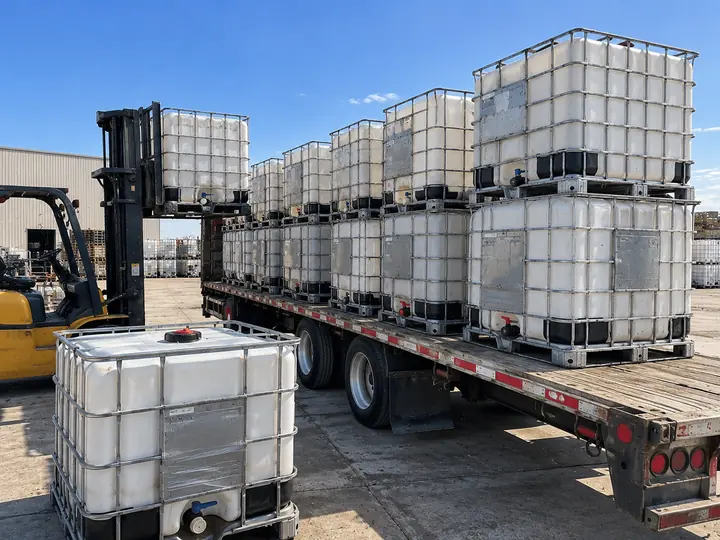
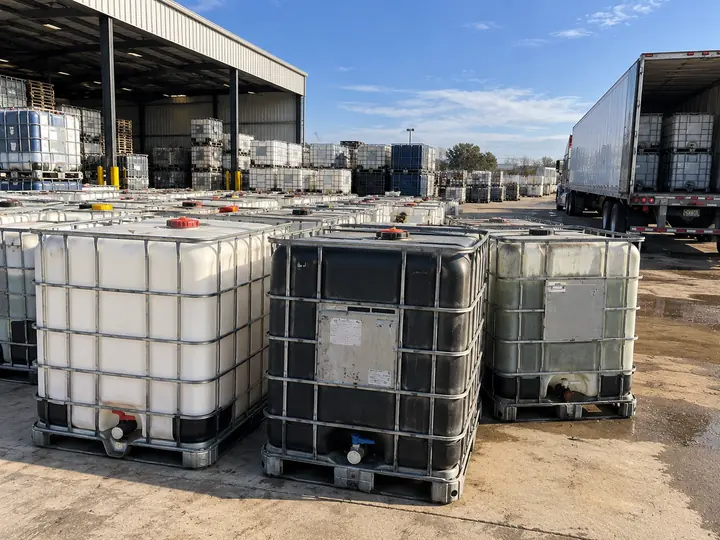
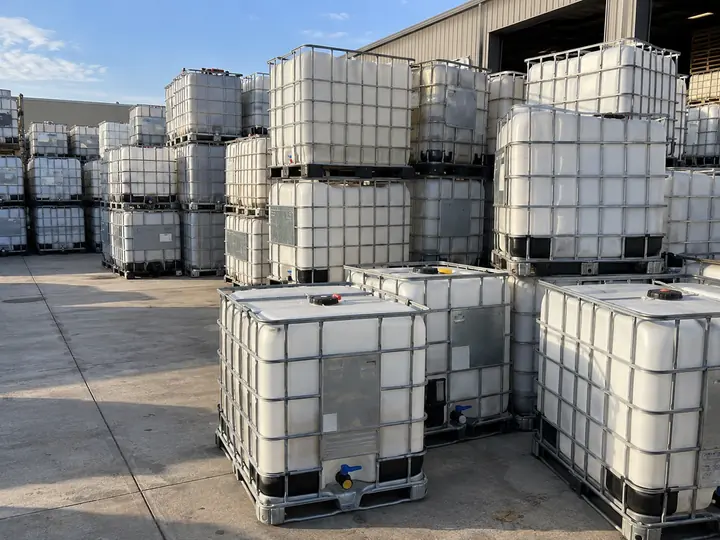
Three frames from the apron.
Grades side by side, plates facing out, and the load plan being executed. This is the whole business in three photographs.
What arrives with the containers.
None of this is optional or chargeable. It is the difference between a reclaimed container and an anonymous second-hand one.
- A prior-contents sheet naming the product, the fill date and the company that filled it
- Four photographs of the actual unit plus an image of the cage stamp
- The grade assigned, and the published criteria that grade commits us to
- A wash record where the unit went through Route 2, 3 or 4, with temperature, dwell, rinse count and final rinse conductivity
- A leak test record for every Grade A and Grade B unit: method, pressure, hold time and measured decay
- The UN plate photograph and periodic test dates where the unit is marked
- A component list naming gasket material, valve type and cap type
- The cage passport ID, so the whole service history can be reissued later
- An allergen flag where a prior food cargo included dairy, egg or tree-nut oils
- A standing take-back offer: when you are finished, we collect and pay
The pages our own staff keep open.
Storing and stacking: the rules, and why each one exists.
Most storage damage we see on returned units comes from four or five decisions, all of which look harmless at the time.
Read the plate before you stack anything
The permissible superimposed load is marked on the UN plate. A zero means do not stack, even empty. Where a figure exists, it assumes a container at normal temperature on level ground with an evenly distributed load above it — not one in July sun, not one on a tilt, not one with a second unit landed on a corner.
Filled stacking
Two high, same footprint, same size, directly aligned cage on cage, on flat bearing ground, below 100 °F ambient. Above 100 °F derate by half; above 120 °F do not stack at all. Never stack a filled 275 on a filled 330, never stack across different footprints, and never stack onto a unit whose cage has cracked nodes or an out-of-square diagonal.
Empty stacking
Four high is routine for transport and two to three high is sensible for standing storage, which is how a 53-foot trailer takes forty empties against twenty filled. Empty does not mean weightless: an empty 275 is still 127 lb on top of whatever is under it.
Racking
An IBC in a rack is held by its base, and the rack needs to be rated for the real gross weight — which means net volume times the actual specific gravity of your cargo, plus tare. A 275 of 50% caustic is 3,637 lb, not 2,420. Racking failures in this trade are almost always a specific gravity arithmetic error rather than a rack defect.
Outdoors
Black or painted bottles only, if the unit is going to live outside. Translucent HDPE in the open loses roughly ten percent of its wall on the sun face in five Michigan years, with the shadow pattern of the cage printed into the plastic where the tubes shaded it. Keep units off bare soil, on gravel or pavers, where meltwater drains away from the base rather than freezing around it.
Secondary containment
Decided by your cargo and your jurisdiction, not by the container. If you need it, size it for the largest single container plus a margin, and remember that a spill pallet rated for a drum is not rated for an IBC.
The boring one that matters
Valve closed, solid cap on, dust cap fitted, in storage. Every time. A valve stored open takes a compression set in the seat and weeps when you finally close it, and that is the single most common post-delivery complaint in this trade.
Chemical compatibility, container by gasket.
| Cargo | HDPE bottle | EPDM | Viton | PTFE | Note |
|---|---|---|---|---|---|
| Water, potable | Excellent | Excellent | Excellent | Excellent | Rebottled or Grade A food only |
| Sodium hypochlorite 12.5% | Good | Fair | Good | Excellent | Vent — the cargo off-gasses and will bulge a sealed bottle |
| Caustic soda 50% | Excellent | Excellent | Good | Excellent | SG 1.53 — 275 gal only, check the forklift plate |
| Sulphuric acid 93% | Not suitable | Not suitable | Fair | Excellent | Lined steel or stainless service, never poly |
| Hydrochloric acid 35% | Good | Not suitable | Excellent | Excellent | Viton only; HCl destroys EPDM in weeks |
| Nitric acid 10% | Fair | Not suitable | Good | Excellent | Oxidiser — embrittles HDPE over months |
| Phosphoric acid 75% | Good | Fair | Good | Excellent | Common fertiliser intermediate |
| Propylene glycol | Excellent | Excellent | Excellent | Excellent | The most-handled tote cargo in the Midwest |
| Ethylene glycol | Excellent | Excellent | Excellent | Excellent | Label clearly — it is routinely confused with PG |
| Ethanol, 190 proof | Good | Fair | Excellent | Excellent | Flammable — conductive container and bonding required |
| Methanol | Good | Fair | Excellent | Excellent | Permeates slowly through HDPE; not for long storage |
| Mineral oil, white | Excellent | Not suitable | Excellent | Excellent | EPDM swells in hydrocarbons |
| Used motor oil | Excellent | Not suitable | Excellent | Excellent | Warm to 60 °F before pumping in winter |
| Diesel and heating oil | Good | Not suitable | Excellent | Excellent | Check local rules before storing fuel in an IBC |
| Vegetable and canola oil | Excellent | Good | Excellent | Excellent | Hot wash route afterwards or it polymerises |
| Urea solution 32.5% (DEF) | Excellent | Excellent | Excellent | Excellent | Freezes at 12 °F, expands, then recovers |
| Liquid fertiliser 28-0-0 | Excellent | Excellent | Excellent | Excellent | Stains the bottle; does not harm it |
| Ferric chloride 40% | Excellent | Not suitable | Excellent | Excellent | Permanent orange staining — cosmetic only |
| Hydrogen peroxide 35% | Fair | Not suitable | Good | Excellent | Vented cap mandatory; dedicated bottle, never reused |
| Acetic acid 80% | Good | Fair | Good | Excellent | Odour carries over — dedicate the unit |
| Latex paint and coatings | Excellent | Good | Excellent | Excellent | Never let it dry inside; a cured film is unremovable |
| Toluene, xylene, MEK | Not suitable | Not suitable | Good | Excellent | Aromatic solvents swell and soften HDPE |
| Isocyanates and polyols | Refused | Refused | Refused | Refused | On our published exclusion list — they cure |
| Firefighting foam concentrate | Refused | Refused | Refused | Refused | PFAS risk; we will not take it at any price |
Ratings are for ambient-temperature storage in a reclaimed container, not for pressurised or heated service. Every 20 °F above 100 °F roughly halves the service life of the rating. When the cargo is not on this list, send us the SDS and we will tell you what we would and would not put it in.
Thirty more terms, including the ones people use loosely.
The glossary page defines sixty-six terms. These are the next thirty, weighted toward the vocabulary that appears in quotes and arguments.
Condition and material
- Crazing — a network of fine branching cracks from chemical and mechanical stress acting together. Absolute disqualifier; never improves.
- Stress whitening — localised opacity where HDPE has been strained, usually a forklift impact at the sump. Not crazing, not automatically a failure.
- Creep — slow permanent deformation under sustained load. Why a hot full tote should never be stacked.
- Environmental stress cracking — cracking under combined stress and a chemical that would harm neither alone. The reason compatibility tables exist.
- Chalking — powdery UV-degraded surface. Cosmetic until it becomes wall loss.
- Ghosting — a faint permanent shadow of a prior cargo visible through the wall. Cosmetic, but it costs a grade.
- Regrind — reprocessed HDPE from our own line, 68% recovery after label and residue loss.
Geometry and handling
- Footprint — the base dimensions, 40 × 48 in on a standard tote. What decides trailer fit.
- Headspace — the deliberately unfilled volume above the cargo. Sixteen percent in winter.
- Heel — the residual cargo left after discharge. Under a gallon is normal; five is a waste job.
- Sump — the recessed low point feeding the valve, and the most common crack location.
- Four-way entry — forks can enter on all four sides. Not universal; ask.
- Superimposed load — the stacking figure on the UN plate.
- Diagonal check — measuring corner to corner to find a cage pushed out of square by impact.
- Node — a welded tube intersection on the cage. 44 to 54 per cage, counted individually.
Closures
- Buttress thread — the asymmetric thread family (S60×6, S70×6, S75×6) that will start on a neighbour and then bind.
- Camlock — quick-connect hose coupling, types A through F plus the DC dust cap.
- Bung — the threaded insert at a port that an adapter seats into.
- Breather valve — a one-way vent for off-gassing cargo such as hypochlorite or peroxide.
- Dip tube — an internal suction tube for pumping. Traps residue; a wash problem.
- Tamper seal — a frangible seal proving the unit has not been opened since despatch.
Commercial and compliance
- Rebottling — fitting a new HDPE bottle into an inspected cage and base. 4,118 units in 2025.
- Take-back — our standing offer to collect and pay for containers at end of use, including reclaim stock.
- Passport — the per-unit record keyed to the cage ID: intake, wash, test, grade, operator, dates. Seven years.
- Prior-contents declaration — the written statement of what was in the unit, from the company that filled it. No declaration, no entry.
- Packing group — the hazard severity band on the UN plate: X covers I–III, Y covers II–III, Z covers III only.
- Periodic test — the 2.5-year leak test and 5-year full inspection that keep a marked unit in regulated service.
- Design type — the approved configuration a UN marking refers to. Properties of the type, not of the individual unit's cleanliness.
- ISPM 15 — the heat-treatment stamp a timber base needs to cross a border.
- Diversion rate — share of intake not landfilled. Meaningless without the residual figure beside it, which is why we publish 94.2% and 4.4% together.
- Avoided emissions — the CO₂e not emitted because a container was reused rather than replaced. Our factors are published in full; we use the end of every range that makes us look worse.
Reference answers on specification.
Do you have 350 and 500 gallon containers?
Yes, as stainless bins rather than caged composites. A 350-gallon square 304 bin is 48 × 42 inches and 55 inches tall with a 420 lb tare; a 500-gallon cylindrical 316L is 52 inches in diameter, 74 tall, 580 lb.
They are the right answer for aggressive acids above SG 1.6, for hot cargo, and for anything where you want a container that will outlive several poly ones. They do not stack, and the trailer count drops to fourteen for the 500s.
What is the heaviest cargo you would put in a reclaimed poly tote?
In practice, 50% caustic soda at SG 1.53 in a 275 — which grosses 3,637 lb — is about where we stop being comfortable, and we check the customer's forklift rating before quoting it.
Sulphuric acid at 93% and SG 1.83 we will not put in poly at all; that is steel or stainless service. The limiting factor is rarely the bottle's burst strength and almost always everything underneath it: forks, beams, floors.
How do I work out whether my cargo is too heavy for a 330?
Multiply litres by specific gravity to get kilograms, or gallons by 8.34 by specific gravity to get pounds, then add the tare — 127 lb for a 275, 145 lb for a 330 — and compare against the maximum gross mass on the UN plate.
The plate figure is the binding one. As a rough guide, cargo above about SG 1.4 belongs in a 275 rather than a 330 simply because the taller bottle puts more mass on the same footprint, and above SG 1.6 you are usually looking at lined steel or stainless rather than poly.
What is the difference between a 275 and a 330, apart from volume?
Height, mostly. Both sit on the same 40 × 48 inch footprint; the 275 is 46 inches tall in the standard build and the 330 is 53. The trailer count is identical at twenty on the floor, which surprises people.
The consequence is density: a 330 full of anything heavy puts more mass on the same square footage, so forklift ratings, racking and floors all need checking against the real figure. For dense cargo, two 275s beat one 330 and a half.
How do I tell which buttress thread I have?
Measure the outside diameter of the male thread: roughly 60 mm is S60×6, 70 mm is S70×6, 75 mm is S75×6. S60×6 is the European norm — Schütz and Werit — and S70×6 covers Mauser and most North American bottles.
The reason this matters is that all three will start on each other and then bind after a turn or two. Two turns and a stop means the wrong standard. Forcing it crazes the bottle neck permanently, and a crazed neck is not repairable.
Which gasket do I need?
EPDM for water, glycols, caustics, fertilisers and most food products. Viton for acids, hydrocarbons, solvents and anything aromatic. PTFE for aggressive oxidisers and where nothing else is rated.
The two expensive errors are EPDM in hydrochloric acid, where it is destroyed in weeks, and EPDM in hydrocarbons, where it swells. If you tell us the cargo we specify the elastomer, and it is on the component list that ships with the unit.
What does the stacking figure on the plate actually mean?
It is the permissible superimposed load: how much mass may sit on top of that container. It assumes normal temperature, level ground and an evenly distributed load, and a zero means do not stack even empty.
The real-world caveat is temperature. Above 100 °F derate by half; above 120 °F do not stack at all. HDPE creeps under sustained load and heat accelerates it, so a stack that was fine in April can deform in July without anything else changing.
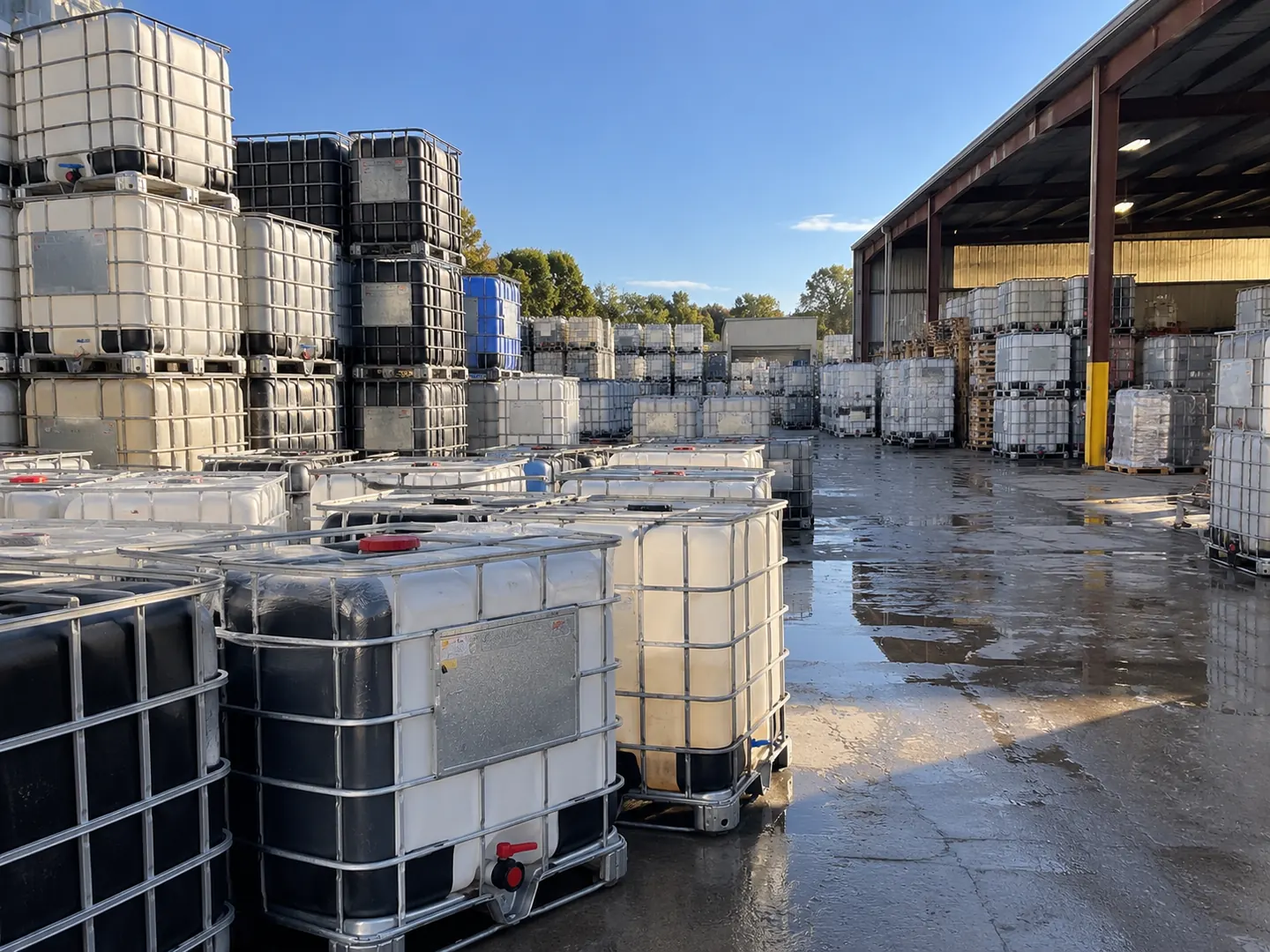
The yard at the hour we start.
One tote or five drums?
A 275-gallon tote holds the same as five 55-gallon drums. They are not interchangeable, and the deciding factor is almost never price.
The tote wins on
- Handling: one forklift move instead of five, one connection instead of five
- Floor space: 13.3 sq ft against roughly 20 for five drums on a pallet
- Dispensing: a 2-inch valve at the bottom beats pumping out of a bung
- Cost per gallon of container, typically by a wide margin
- Record keeping: one cage ID and one wash record instead of five of each
- Freight: 20 totes a trailer is 5,500 gallons; 80 drums is 4,400
Drums win on
- Splitting a batch across sites, days or production lines
- Weight per unit — one person with a drum dolly, no forklift
- Dedicating a container per cargo without dedicating a tote
- Aggressive cargo above SG 1.6, where lined steel drums are the practical answer
- Small-volume cargo where a part-full tote means a year of headspace and oxidation
- Sites with no forklift, no dock and no level bearing ground
Symptom, cause, what to do about it.
| Symptom | Most likely cause | Check first | Fix |
|---|---|---|---|
| Weeping at the valve when closed | Seat compression set from long open storage | Close fully, wipe dry, watch 10 min | Replace the valve; store closed in future |
| Drip from under the valve body | Flange gasket, not the valve | Feel behind the valve for wet | Pull the valve, new flange gasket |
| Cargo odour in a clean tote | Original gasket retained, or cap gasket | Smell the gasket itself, off the unit | New gasket; re-rinse; air with the cap off |
| Bottle bulging at mid-wall | Overfill, heat, or off-gassing cargo | Cargo SDS for gas generation; ambient temp | Vented cap at point of use; reduce fill to 85% |
| Condensate on top of the cargo | Vented cap left on in storage | Which cap is fitted | Solid cap for storage; vent only when dispensing |
| Crack at the lower corner | Water-based cargo froze at full fill | Fill level history | Unit is finished — we will take it back for reclaim |
| White cloudy patch at the sump | Stress whitening from forklift impact | Raking light for branching cracks | Monitor; no crazing means serviceable, Grade C |
| Fine branching cracks | Crazing, from chemical stress or UV | Any raking light at a shallow angle | Retire the bottle; the cage and base are reusable |
| Flow stops mid-discharge | Vacuum lock — no air in | Crack the top cap and listen | Vent while dispensing, always |
| Slow flow on a cold morning | Cargo viscosity, not a blockage | Cargo temperature against its SDS | Warm the product; never heat the bottle directly |
| Adapter binds after two turns | Wrong buttress standard | Compare S60×6 / S70×6 / S75×6 | Correct adapter or a proper reducer; never force |
| Cage node cracked | Impact, or a stacked load over rating | Count cracked nodes; check plate stack rating | Do not stack; return for cage swap |
| Tote rocks on the forks | Base weld failed at one corner | Lift 2 in and look at all four welds | Take out of service immediately — transplant job |
| Rust bleeding through the zinc | Galvanising breached, usually at a weld | Wire-brush a test patch | Cosmetic for utility use; fails food-grade intake |
| Label illegible after a season | Direct-print on HDPE in UV | Whether the UN plate is also fading | Stencil and clear-coat, or stainless tag |
Temperature limits and the derating nobody mentions.
| Temperature | HDPE bottle | Steel cage | Gasket | Stacking allowed | Practical effect |
|---|---|---|---|---|---|
| Below −20 °F | Brittle | Fine | Hardened | No | Impact cracking at the sump corner; do not forklift a cold full tote hard |
| −20 to 32 °F | Serviceable | Fine | Stiff | Yes, derate 25% | Water-based cargo freezing; fill to 85% only |
| 32 to 100 °F | Full rating | Full rating | Full rating | Yes, full | Normal service window — every published figure assumes this |
| 100 to 120 °F | Softening | Fine | Fine | Derate 50% | Visible bulge in a full tote standing in July sun |
| 120 to 140 °F | Marginal | Fine | Check cargo | No | Creep accelerates; never stack, never rack |
| 140 to 160 °F | Short excursion only | Fine | EPDM limit | No | Wash bay territory — empty units only |
| Above 160 °F | Not suitable | Fine | PTFE only | No | Permanent deformation; the unit leaves as Grade D |
Heat-affected HDPE does not recover its original wall strength when it cools. This is why anything that has been near a fire is refused at our gate regardless of how it looks.
Reference answers on use.
How long can I leave a cargo sitting in a tote?
The container is usually not the limit — the cargo is. Hypochlorite loses strength continuously and faster when warm. Hydrogen peroxide off-gasses and needs a vent throughout. Vegetable oils oxidise. Latex is finished if it freezes. Glycols and fertilisers are indefinitely stable.
For the container itself: solid cap, valve closed, out of direct sun, filled to 85% if the cargo is water-based and the temperature will drop below freezing. Under those conditions a sound bottle will sit for years without any change we can measure.
Can I store drinking water in a reclaimed tote?
In a rebottled unit, yes — a new HDPE bottle in an inspected cage, with an FDA-compliant EPDM gasket and new closures. For potable water that is the only option we will sell you.
Not in a washed unit, however good the wash. The bottle has a history, and for drinking water the correct answer to 'what was in it before?' is 'nothing'. Keep it out of sunlight, use it within a season, and treat the water as your own responsibility rather than the container's.
Is a tote safe for diesel or heating oil?
The container handles it: HDPE is good with diesel and a Viton gasket is correct — never EPDM, which swells in hydrocarbons. The constraint is almost never the tote.
It is your local fire code, insurer and state environmental rules, which often restrict storing fuel in a non-metallic container, require secondary containment, or cap the volume on site. Check before you buy, because the container will arrive compliant and the installation may not be.
Can I use a tote for compost tea or digestate?
Yes, and Grade B rinsed is the right stock for it. The one rule is venting: biological activity generates gas, and a sealed cap on a fermenting cargo will bulge the bottle and eventually deform it permanently.
Fit a vented cap or a breather valve at the point of use, keep the unit out of direct sun to limit the temperature swing, and expect to wash it out between batches rather than at end of season.
What size tote for livestock water?
A 275 on a level bearing pad, Grade B rinsed with a documented prior cargo, black or painted rather than translucent. Translucent bottles grow algae in one season in the open.
Our framed trough build is the better answer if animals have direct access: a half-height open trough, 120 gallons, with the cage left intact as the frame. Full totes should never be where livestock can rub against them — 2,420 lb on four square feet does not need much persuasion to tip.
Can I heat the contents of a tote?
Gently and indirectly, never with a direct heat source on the wall. A blanket rated for IBC use, or a warm room, is fine. A torpedo heater pointed at the bottle, a flame, or any local hot spot is not.
Keep the cargo below 100 °F for normal service. Above that the bottle softens, creep accelerates and the stacking rating halves; above 120 °F do not stack at all. Heat-affected HDPE never recovers its original wall strength, and the failure comes later with no visible warning.
How do I get the last of the cargo out?
Tip the unit forward slightly so the sump is the low point, and vent the top cap while you drain — most 'the valve is blocked' calls are a vacuum lock, not a blockage. Crack the cap and listen for air.
Expect to leave under a gallon as heel in a standard sump. If recovering that last gallon matters to your economics, ask about units with a dedicated discharge geometry rather than fighting a standard sump.
The twenty-two point intake inspection.
| # | Check | Pass criterion | Fail consequence |
|---|---|---|---|
| 01 | Prior-contents declaration present | Named product, filler, fill date | Quarantine bay until named, or refused |
| 02 | Cargo against exclusion list | Not on the published list | Refused at the gate, load turned away |
| 03 | Residual heel volume | Under 1 gal, drainable | Charged back, or refused above 5 gal |
| 04 | Odour, cap off, ambient | No detectable cargo odour after rinse | Drops to Grade C or reclaim |
| 05 | Bottle wall thickness, four points | Within 15% of nominal | Reclaim |
| 06 | Crazing under raking light | No branching cracks anywhere | Reclaim — crazing never improves |
| 07 | Stress whitening at the sump | None, or faint and non-progressive | Grade C maximum |
| 08 | Bulge, measured at mid-wall | Under 6 mm from datum | Grade C or reclaim by severity |
| 09 | UV chalking on the sun face | Surface only, no wall loss | Grade C for outdoor-only use |
| 10 | Neck thread condition | Clean start, two full turns by hand | Rebottle or reclaim |
| 11 | Internal scope, 360° | No film, no deposit, no shadowing | Re-wash, then regrade |
| 12 | Weld node count and integrity | 44–54 nodes, none cracked | Cage repair or scrap the cage |
| 13 | Cage geometry, diagonal check | Within 10 mm across diagonals | Press back or scrap |
| 14 | Galvanising condition | No red rust through the zinc | Grade C, or wire-brush and paint |
| 15 | Base weld to pallet | All welds sound under load | Scrap the base, transplant the bottle |
| 16 | Pallet type and ISPM stamp | Matches order; stamp present if export | Re-sorted to the correct bay |
| 17 | UN plate legible | All fields readable, dates in date | Sold as non-regulated service only |
| 18 | Leak test, pneumatic decay | Under 1 kPa loss in 10 min at test pressure | Repair and retest, or reclaim |
| 19 | Valve function, full travel | Opens, closes, seals dry | Valve replaced |
| 20 | Gasket condition | Not reused on A or B — always new | New gasket fitted |
| 21 | Photographs, four plus cage stamp | In focus, bay number visible | Reshot before despatch |
| 22 | Passport record written | Cage ID, grade, route, dates, operator | Unit does not leave the yard |
Checks 05 to 09 are where most units lose a grade, and they are all condition of the bottle rather than cleanliness. A container can be surgically clean inside and still be Grade C because of what five Michigan winters did to the outside.
What actually moves the price of a reclaimed tote.
| Driver | Direction | Typical effect | Can you control it? |
|---|---|---|---|
| Grade | A costs more than C | Up to 3× across the range | Yes — most buyers over-specify |
| Wash route required | Route 3 over Route 1 | +18 to +30% | Yes, by naming the real end use |
| New bottle (rebottled) | Up | +40 to +60% over washed | Yes — only food and potable truly need it |
| Quantity against trailer fit | 20, 40, 60 are efficient | ±15% on delivered cost | Yes, and this is the easiest saving |
| Freight zone and lane | Lane beats distance | ±40% on delivered cost | Partly — ask which day we run your lane |
| Season | B and C peak in spring | +15 to +20% March–May | Yes, if your timing is flexible |
| Pallet base specified | Steel or composite over timber | +4 to +20% on the base | Yes |
| New valve and cap | Up | Fixed per unit | Yes — reconditioned hardware is an option on C |
| UN plate in date | Up | +8 to +12% | Only if your cargo is regulated |
| Resin and scrap steel index | Both directions | Moves the whole market | No |
| Diesel | Up with fuel | Freight line only | No |
| Take-back credit on your old units | Down, against the invoice | Offsets part of the order | Yes — ask before you dispose |
We quote containers and freight as separate lines, because a single delivered number hides which of these twelve things you are actually paying for. If a quote you are comparing does not split them, ask.
Reference answers on impact.
What is the single biggest impact in the whole chain?
Making the container in the first place. Everything else — washing, freight, our yard electricity, the fleet — is small against the cradle-to-gate impact of 42 lb of virgin HDPE and 86 lb of virgin steel.
Which means the highest-leverage decision in this entire industry is not which supplier you buy from. It is whether the container you are about to buy needs to be new, and for most cargo the honest answer is no.
Does freight cancel out the benefit?
Not remotely, at the distances involved. At 0.40 kg CO₂e per mile for a trailer carrying twenty units, a 500-mile delivery is about 10 kg CO₂e per container. Avoiding one new tote is in the region of 150 kg CO₂e.
It matters at the margins, which is why we run six scheduled lanes and chase backhaul utilisation — 41% of our return legs are loaded. But no plausible freight distance in the lower 48 makes reuse the worse option.
What happens to the parts you cannot reuse?
HDPE goes to flake at 68% recovery after label and residue loss. Steel is baled and mill-confirmed at 92%. Contaminated fractions go to energy recovery — 535 units' worth in 2025, 1.4% of intake.
The genuine residual is gaskets, labels, adhesive and wash sludge: 4.4% of intake by unit count, 61,428 lb by weight. We publish it rather than rounding it away, and the weight comes from the scale rather than from a unit count.
How do you calculate avoided emissions?
Mass times factor, with every factor published. A reused container avoids the cradle-to-gate impact of the new one it displaced: 42 lb of HDPE at 1.86 kg CO₂e per lb, 55 lb of steel at 0.86, 31 lb of steel pallet at the same, less the 2.3 kg CO₂e of the wash cycle and the freight at 0.40 kg CO₂e per mile.
Where a published range exists we use the end that makes our own numbers look worse — 1.86 against a range up to 2.4 for HDPE, for example. That systematically understates our impact, which is the direction we would rather be wrong in.
Why do you publish a landfill figure?
Because a diversion rate without a residual figure is a marketing number. Ours was 94.2% diverted and 4.4% to landfill in 2025 — gaskets, labels, adhesive and wash sludge, 61,428 lb of it, weighed on the yard scale.
If a supplier quotes you a diversion percentage and cannot immediately tell you what the residual was and what it consisted of, the percentage is not measured. It is estimated, and estimates in this industry drift upward.
Is reuse really better than recycling?
By a wide margin, for this product. Recycling a tote recovers 68% of the HDPE and 92% of the steel and then spends energy turning flake back into a product. Reusing it spends 2.3 kg CO₂e on a wash and keeps 100% of both materials doing the job they were made for.
That is why our disposition table reads 61.4% resold as containers and 18.9% reconditioned, with recycling at 7.2%. Recycling is what we do when reuse has genuinely been exhausted, not as a first resort with a better story attached.
What is the water footprint of a wash?
11.5 gallons of fresh water per container, metered across 2025 and across all four routes, because the rinses cascade and 86% of bay water recirculates.
Against that, making the HDPE bottle it displaced would have used about 4.1 gallons per pound of process water on the low end of the published range — roughly 172 gallons for a 42 lb bottle — plus 1.2 gallons per pound for 86 lb of steel. The wash is not close to being the expensive part.
How the container in your yard came to be shaped like that.
The modern caged IBC is a surprisingly young object, and almost every feature of it is the fossil of a specific problem.
Drums and nothing between
Liquids moved in 55-gallon drums or in bulk tankers. Anything in between meant handling dozens of drums, which is why the intermediate category was invented at all.
The first rigid composites
A blow-moulded plastic bottle inside a steel frame, sized to a pallet footprint so a forklift could handle it. The idea has not changed since.
The pallet footprint settles
40 × 48 inches in North America, 1,200 × 1,000 mm in Europe. Every trailer count on this site descends from that choice.
UN performance testing
Packagings began to be approved by design type and performance test rather than by prescription, which is where the 31HA1 marking family comes from.
Periodic testing arrives
The 2.5-year leak test and 5-year inspection cycle formalised, creating the date-stamped plate that decides whether a used unit can still carry a regulated cargo.
Reconditioning becomes a trade
Enough units in circulation, and enough value in a steel cage that outlasts three bottles, for washing and rebottling to be businesses rather than favours.
One bay and a used pressure washer
Re:IBCtote starts in a rented bay in metro Detroit, washing totes for local chemical blenders who could not get a straight answer about prior contents.
Grading gets published
We write down the disqualifiers rather than keeping them in an inspector's head, because the arguments about Grade B were taking more time than the washing.
The passport
Every unit gets a record keyed to its cage ID: intake, wash parameters, test results, grade, operator, dates. Seven-year retention, reissuable years later.
38,210 containers
Our largest year: 94.2% diverted, 4.4% residual published rather than rounded away, 4,281 tonnes of CO₂e avoided on factors we publish in full.
The same containers, different weather.
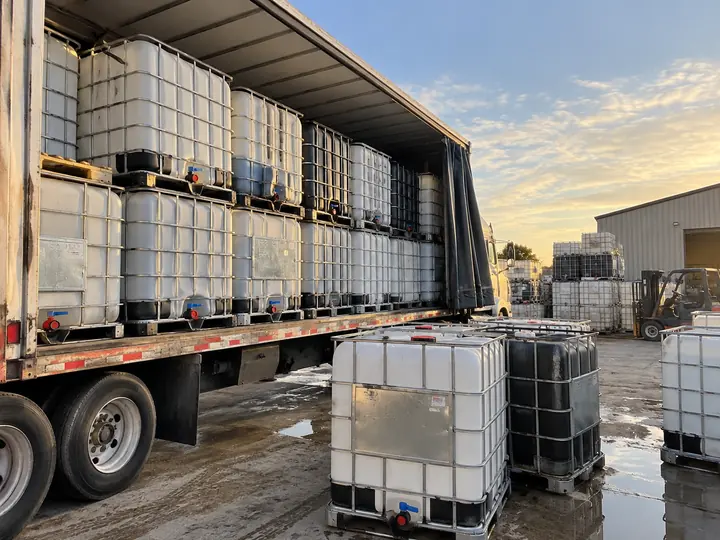
“Nobody has ever called us about a container failing. They call about a forklift, a rack or a floor, and it is always the same arithmetic: they multiplied gallons by 8.34 and the cargo was not water.”
Send us the cargo, not the grade.
Tell us what is going in the container and what you are doing with it, and we will name the grade, say what would disqualify a unit from it, and tell you if something cheaper does the job. That last part is why people come back.